How to Make Your Room Aesthetic DIY

A complete, practical guide — from bare walls to a space that actually looks the way you imagined it.
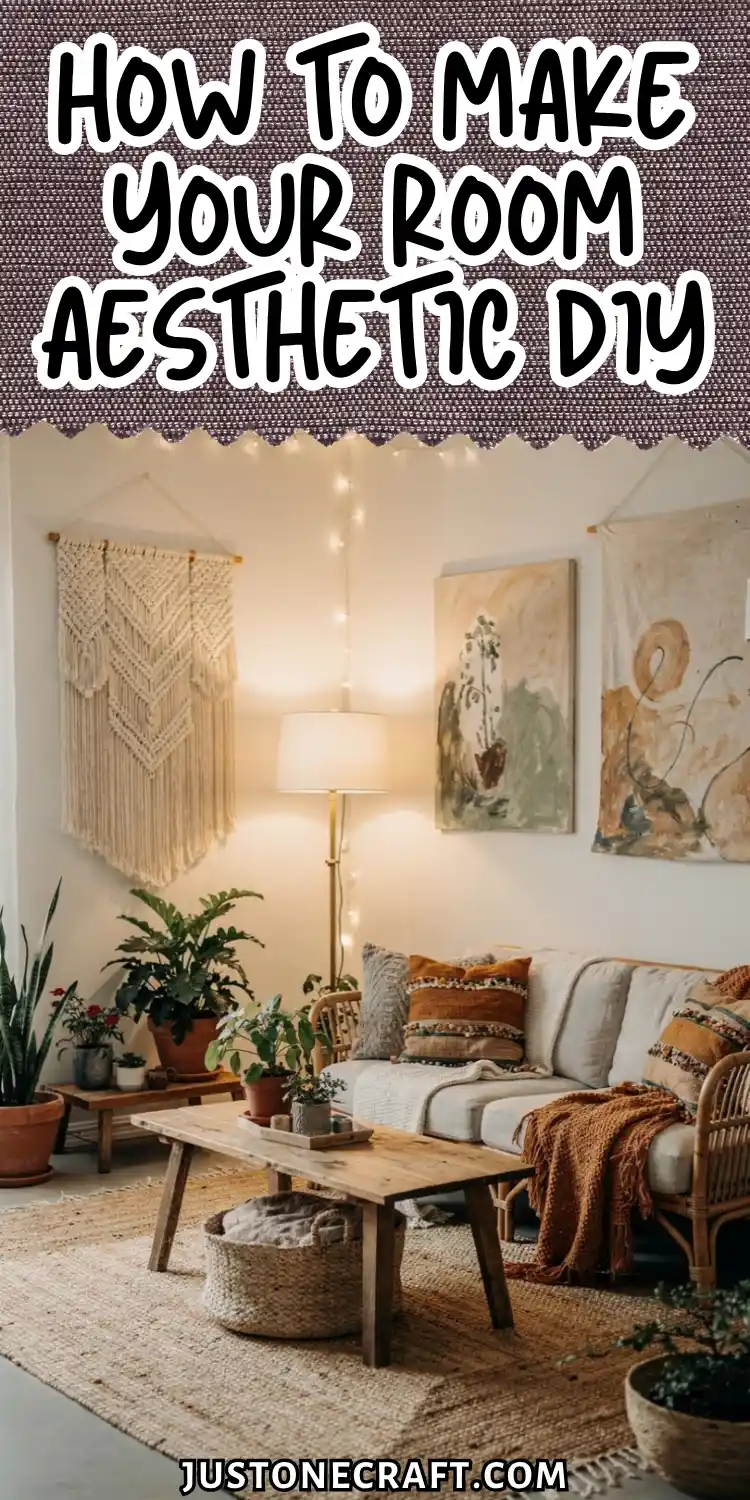
Your room is the one space you control entirely, and making it visually cohesive changes how you feel every time you walk in.
Most DIY aesthetic room guides fail because they hand you a shopping list without the visual logic behind it — so you end up with a pile of cute objects that somehow still look like nothing.
Why Aesthetic Rooms Work — The Visual Logic Behind It
Your brain reads a room in under 90 milliseconds, scanning for visual harmony — similar enough to feel cohesive, varied enough to stay interesting.
Color is 80% of it. Too many competing dominant colors reads as chaos. Fix it with the 60-30-10 rule: 60% dominant (walls, bedding, large furniture), 30% secondary, 10% accent.
Texture and scale do the rest. Same color, same texture = flat and cheap. Mix matte with glossy, rough with smooth, large anchor pieces with small clusters. Think of it like audio: bass (large pieces), midrange (medium decor), treble (small details). Missing any layer and the room feels incomplete.
Lighting overrides everything. Warm bulbs (2700–3000K) make any color feel intentional. Cool white (5000K+) makes even great decor look clinical. Most rooms look cheap because of the bulb, not the stuff in them.
What You Need Before You Start
Color Anchor
Peel-and-stick wallpaper ($25–40/roll, covers ~20 sq ft) or 1 quart matte latex paint (~$15). One accent wall only. Matte or eggshell finish — no satin or gloss on rental walls.
Lighting (most skipped, highest impact)
- Warm string lights, 33 ft — Govee or Twinkly, $15–25. Skip the cheap 6 ft sets.
- Clip lamp + Philips 2700K bulb — $26 total. Replaces overhead as your evening light source.
- LED strip lights (optional) — 16.4 ft roll, $12–20. Under bed or behind monitor.
Wall Decor
3M Command strips only (medium + large pack). Print art on Canva, print at Walgreens for $0.50–3. Skip Amazon prints — they look assembled, not curated.
Textiles
- Throw blanket ($20–35) — chunky knit or velvet, in your secondary color.
- 2 standard pillowcases + 1 accent pillow ($25–40 total). Max 5 pillows on any bed.
- Rug, 4×6 ft — IKEA STOENSE or TEJN, $40–80. Most skipped, most regretted.
Shelves + Surfaces
IKEA LACK shelves ($9 each). 1 plant per cluster (pothos or snake plant; faux is fine, spend $15+). Max 5 objects per shelf — books, candle, ceramic, one personal item. Odd numbers only.
Step-By-Step: How to Build the Aesthetic
Step 1 – Lock your aesthetic
Pick 3 words (“warm, minimal, cozy”), save 15 Pinterest images. If they share a color and 2 textures, you have your palette. If not, try new words.
Step 2 – Swap your bulb first
A 2700K warm white LED ($10) makes the room feel instantly cozier and shows you what actually needs changing.
Step 3 – Create one anchor wall
Paint or wallpaper the wall visible from your door in your dominant color. Everything else organizes around it.
Step 4 – Layer the bed
Duvet in dominant color, throw folded at a slight diagonal across the bottom third, accent pillow off-center. Step back 5 feet — it should look intentional.
Step 5 – Build your wall cluster
Mock the arrangement on the floor first, then tape it to the wall before committing. Central large piece, 4–6 smaller ones, 2–3 inches apart. Shelves at eye level, styled in trios: tall + mid + low.
Step 6 – Run your lights, do a final sweep
LED strips under the bed or desk, string lights above the gallery wall. Kill the overhead, stand at the doorway. Fix anything that pulls focus for the wrong reason.
Keeping It Looking Good Over Time
The most common way aesthetic rooms fall apart is gradual clutter creep: items accumulate on flat surfaces until the curated arrangement disappears under daily life.
Prevent this with one simple rule — every surface has a defined capacity, and anything new that comes in requires something to leave. Set a 10-minute weekly reset where you return each object to its designated spot.
Dust your shelves every 2 weeks with a microfiber cloth. Plants need seasonal rotation toward the window if they start leaning. String lights typically last 2–3 years before LEDs start dimming — replace the full strand rather than trying to identify single bulb failures.
Command strips leave clean removal if you pull the tab parallel to the wall slowly — never pull perpendicular, which risks damaging drywall. Remove strips before temperatures drop below 50°F; cold makes the adhesive brittle.
Aesthetic Variations to Build from This Base
Dark Academia — Hunter green, burgundy, or charcoal. Stacked vintage books instead of shelves. Edison bulb cage lamp. World map or botanical prints. Textures: leather, dark wood, linen.
Cottagecore — Cream, sage, or dusty pink. Pressed flower or watercolor art. Macramé as your anchor wall feature. Fairy lights over LED strips. Dried flowers ($8–15, last up to a year). Textures: cotton, jute, rattan.
Minimalist / Clean Girl — 2 colors only: white or cream + one muted tone. Max 2 wall prints, widely spaced. One large mirror instead of a gallery wall (IKEA HOVET, ~$70). Every shelf object must be decorative and functional. This aesthetic costs less — the discipline is in removing, not adding.
Y2K / Retro — Chrome, hot pink, electric blue, or orange. RGBIC LED strips as the star. CD arrangements, magazine collages, retro typography posters. A $12 disco ball does most of the work. Textures: iridescent against matte walls.
Quick Troubleshooting Reference
| Problem | Likely cause | Fix |
|---|---|---|
| Room looks cluttered even after decorating | Too many competing colors or scales with no visual hierarchy | Remove all items from one surface. Reintroduce only 3 objects max. Apply the 60-30-10 color rule. |
| Looks like a store, not a personal space | All items purchased together from one retailer; no personal layer | Add 3 personal photos, one handmade or thrifted item, and one object with a story. |
| Looks great in photos but feels flat in person | Lighting is too harsh or uniform; no warm glow layer | Add a warm-toned lamp at lower height. Use lamps only after 6 PM; turn off overhead. |
| Gallery wall looks random and messy | Inconsistent frame styles or spacing; no focal centerpiece | Remove all frames. Identify one hero piece. Build outward from it with consistent 2–3 inch spacing. |
| Plants look fake or sad | Wrong light placement, or cheap faux plant with plasticky leaves | Move real plants within 3 ft of window. Replace cheap faux plants with fabric or dried options. |
| Room reverts to messy within 2 weeks | No defined home for everyday objects (keys, bags, chargers) | Add one catch-all basket or tray per surface. Clutter with a defined container looks styled. |
Final Tip
Stop thinking of your room as a finished product and start thinking of it as a palette. Professional interior stylists don’t “finish” a room — they set a visual system and then make decisions within it.
Once you know your dominant color, your texture pair, and your lighting temperature, every future purchase becomes a simple yes-or-no question: does this fit the system?
That question replaces the anxiety of “does this look good?” and makes every addition feel deliberate rather than random. The aesthetic isn’t a destination. It’s a set of rules that makes the destination obvious.