How to Make Slime Without Glue (Easy DIY Guide)

Glue-free slime is a fully stretchable, satisfying slime made from everyday kitchen or bathroom staples — no craft store trip required. If you’re out of PVA glue or simply want a safer, non-toxic version kids can play with immediately, this is your fastest path.
How It Works
Traditional slime works by cross-linking the long polymer chains in PVA glue using a boron-based activator like borax.
Those chains lock together through boron bridges, creating a semi-solid network that flows slowly but holds its shape.
Glue-free recipes replicate this using different polymer sources. Psyllium husk contains long polysaccharide chains that behave similarly — heat causes them to hydrate and entangle into a stretchy gel.
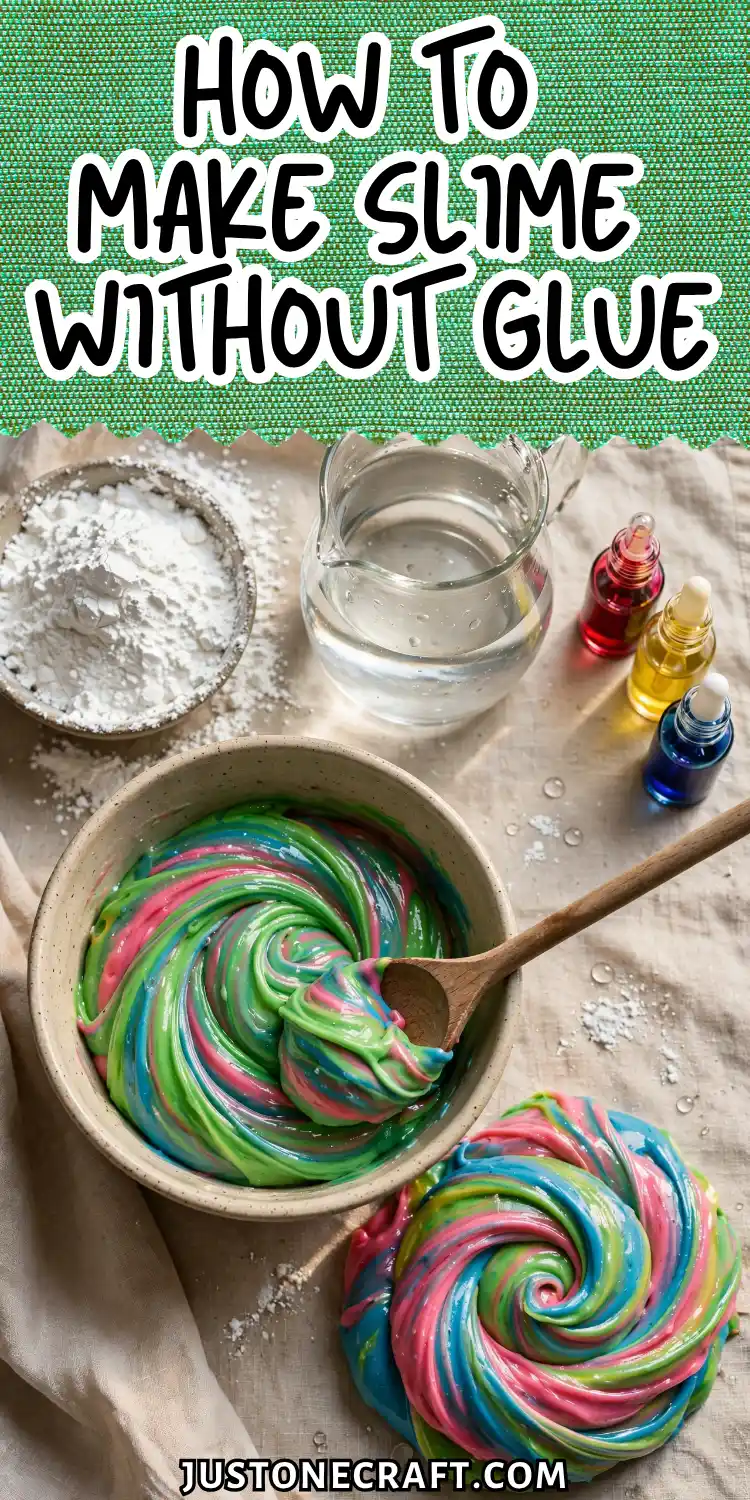
Cornstarch works differently: it’s a non-Newtonian fluid whose particles lock together under pressure but flow freely when relaxed.
That’s oobleck, not true slime — satisfying in its own way, but a different experience entirely.
Pick your type before you start: psyllium husk for stretch, cornstarch for pressure-reactive fun.
🧪
Psyllium Husk
Stretchy, gel-based
🌽
Cornstarch
Pressure-reactive oobleck
What you need
For psyllium husk slime (stretchy, gel-based):
💧 Psyllium Ratio
1 tbsp husk : 1 cup water
💧 Oobleck Ratio
1 cup starch : ½ cup water
- Psyllium husk powder — 1 tablespoon. Must be the powder form, not whole husks. Whole husks won’t hydrate evenly and leave lumps. Metamucil (unflavored) works perfectly. Flavored versions will smell sweet but won’t affect texture.
- Water — 1 cup (240 ml). Tap water is fine. Distilled water produces a slightly cleaner, clearer result.
- Food coloring — 3–5 drops. Optional, but add it to the water before cooking so it distributes evenly.
- A microwave-safe bowl with at least double the volume of your mixture — it bubbles up significantly.
- A spoon or silicone spatula for stirring. Metal works, but silicone releases cleaner.
For cornstarch slime (oobleck, pressure-reactive):
- Cornstarch — 1 cup (128 g). Plain cornstarch only. Flour, arrowroot, or baking powder won’t produce the same suspension effect.
- Water — ½ cup (120 ml). Start with slightly less and add more in small increments — ratio is everything.
- Food coloring — 3–5 drops. Stir into water first.
Step-By-Step: Psyllium Husk Slime
Step 1: Combine psyllium husk powder and water. Add 1 tablespoon of psyllium husk powder to 1 cup of water in your microwave-safe bowl.
Stir for 30 seconds until the powder is fully dispersed — no dry clumps sitting on the surface. At this stage it will look like slightly cloudy water. That’s correct.
Step 2: Add food coloring. Drop in 3–5 drops of your chosen color and stir until uniform. Do this before microwaving — adding color afterward makes it nearly impossible to mix evenly into the gel.
Step 3: Microwave on high for 3 minutes. Place the bowl uncovered in the microwave for 3 minutes. It will bubble around the 2-minute mark — don’t interrupt it.
When done, the mixture should be thick, slightly translucent, and pulling away from the bowl edges.
If it still pours freely, microwave in 30-second bursts until it holds its shape when scooped.
⏱️ Watch Closely: Bubbling starts around the 2-minute mark — that’s normal, don’t stop it. Mixture is ready when it pulls away from the bowl edges.
Step 4: Let it cool for 20–25 minutes. Don’t touch it yet. The gel is still loose and extremely hot. As it cools, the polysaccharide network firms up. Set a timer — rushing this step is the #1 reason people end up with runny results.
Step 5: Knead the slime. Once cool enough to handle comfortably, scoop it out and knead for 1–2 minutes.
You’ll feel it transition from sticky and fragile to smooth and elastic. If it tears instead of stretches, it needs another 5 minutes of cooling time.
Step-By-Step: Cornstarch Slime (Oobleck)
Step 1: Pour cornstarch into a bowl. Measure 1 cup (128 g) and add food coloring to ½ cup of water separately, then pour the colored water into the cornstarch slowly — not the other way around.
Step 2: Mix slowly with your hands. Stirring with a spoon creates resistance and looks “wrong.”
Use your fingers and mix slowly. The mixture should feel solid when you press quickly and liquid when you move slowly.
If it’s too runny, add cornstarch 1 tablespoon at a time. If too stiff, add water 1 teaspoon at a time.
Storage
Psyllium husk slime: Store in an airtight container or zip-lock bag in the refrigerator. It lasts 3–5 days before drying out or developing an off smell. Do not leave at room temperature for more than a few hours.
Cornstarch slime: Best made fresh. It dries out within hours at room temperature. You can reconstitute it by adding a small amount of water and re-mixing with your hands.
Variations
Glow-in-the-dark slime: Add 1 tablespoon of glow-in-the-dark paint to the psyllium husk mixture before microwaving. Charge under a bright light for 30 seconds and it glows for 5–10 minutes in the dark.
Scented slime: Add 2–3 drops of essential oil (lavender, peppermint) during Step 1. Heat won’t destroy the scent — it sets into the gel as it cools.
Glitter slime: Stir in 1 teaspoon of fine cosmetic glitter after kneading. Chunky glitter works but affects stretchiness by disrupting the polymer network.
Galaxy oobleck: Make cornstarch slime and swirl in 2–3 colors without fully mixing. The marbled effect is permanent as long as you don’t fully knead it together.
Troubleshooting
| Problem | Likely cause | Fix |
|---|---|---|
| Slime won’t stretch, tears immediately | Undercooked or still too warm | Microwave for 30 more seconds; let cool fully |
| Slime is sticky and won’t hold shape | Too much water or not enough cooking time | Microwave in 30-second bursts; dust hands lightly with cornstarch |
| Oobleck is completely liquid | Too much water | Add cornstarch 1 tbsp at a time |
| Oobleck is crumbly and solid | Too little water | Add water ½ tsp at a time |
| Uneven color in psyllium slime | Color added after cooking | Dissolve color in water before microwaving next time |
| Slime developed a smell after 2 days | Bacterial growth in organic material | Discard and make fresh; always refrigerate between uses |
One Final Thought
Both of these recipes teach you the same underlying principle: slime is just a polymer network holding water in place.
Once you see it that way, troubleshooting becomes intuitive — if it’s too runny, the network is too weak (more cooking time or more starch).
If it’s too stiff, the network is over-formed (more water). Every slime problem you’ll ever face traces back to this one dial: network strength. Adjust it, and you can fix anything.