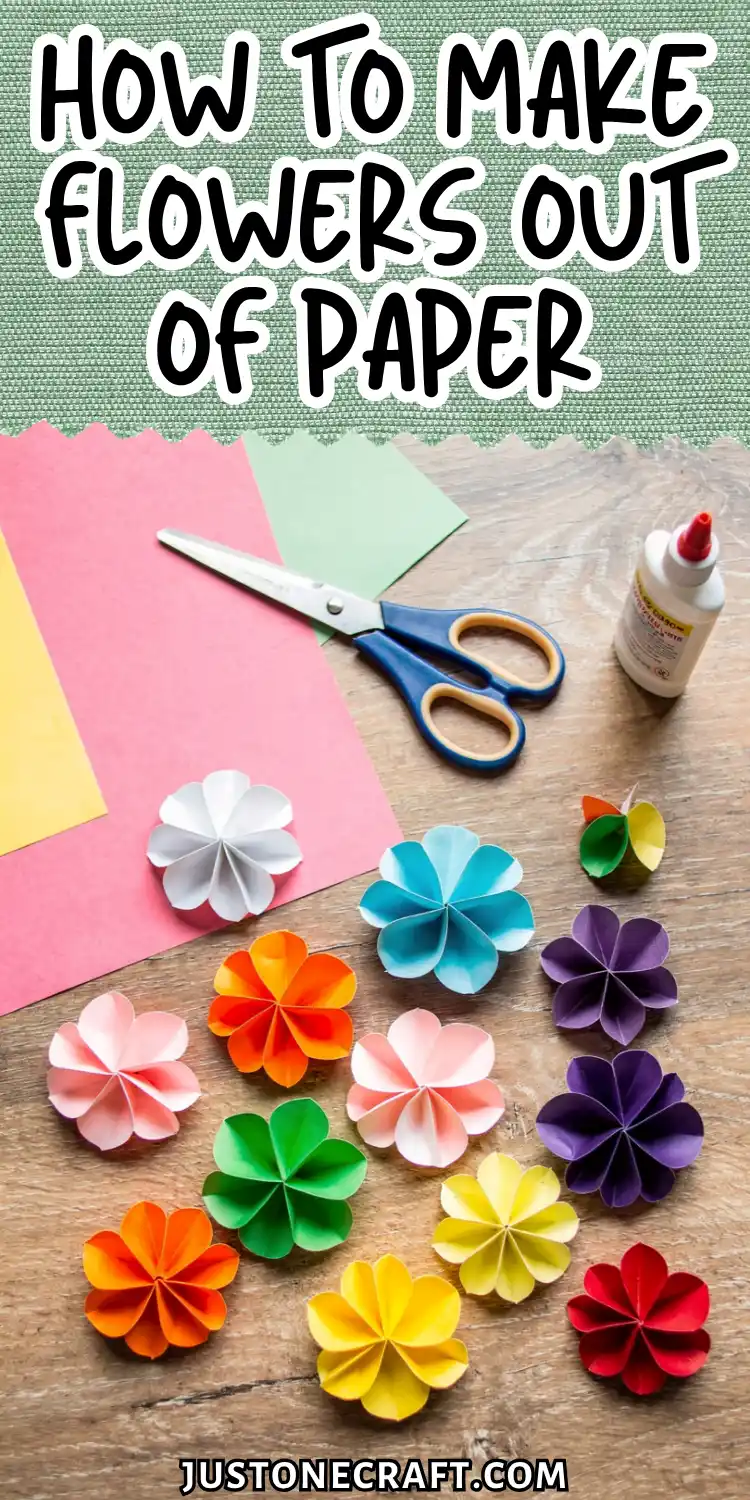
How to Make Flowers Out of Paper

Paper flowers are handcrafted blooms made by cutting, shaping, and assembling paper into three-dimensional floral forms. Done right, they outlast any real arrangement and cost a fraction of what florists charge — which is why they show up everywhere from wedding arches to gift toppers.
Why Paper Holds a Flower Shape
Paper holds its shape because its fibers remember folds and curves. Curling the paper creates natural-looking petals, while layering several petals adds depth and realism. A secure but balanced center keeps the petals spread evenly, giving the flower its final lifelike form.
What You Need
Paper (the most important choice)
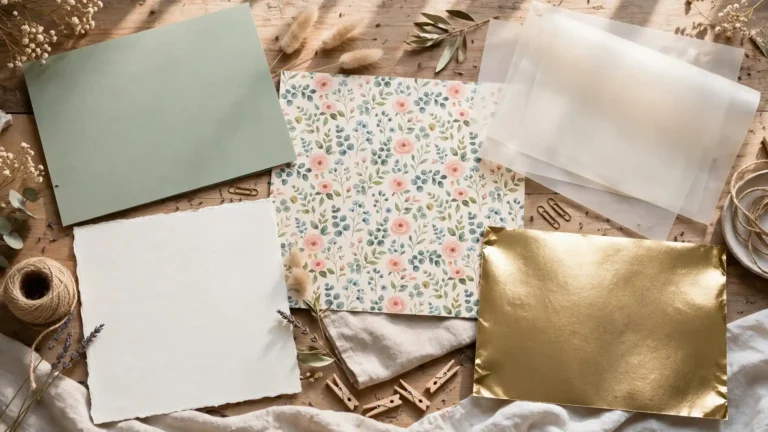
- Crepe paper, 60 g/m² or 180 g/m²: The standard for realistic flowers. The 60 g/m² (Italian doublette or German) is thin enough to stretch and curl into soft petals. The 180 g/m² holds structure for roses and dahlias with thick petals. Avoid craft store crepe streamers — they’re too thin, tear easily, and the colors bleed when touched.
- Cardstock, 65 lb (176 g/m²): For graphic, geometric flowers like paper dahlias or anemones. Doesn’t curl as naturally but holds crisp folds perfectly.
- Tissue paper: Budget option for volume projects like pom-pom flowers. Won’t look realistic up close, but works well for parties and backdrops at scale.
Tools
- Sharp scissors or a craft knife + cutting mat: Blunt scissors crush crepe paper fibers instead of cutting them, leaving ragged edges that show. A craft knife gives cleaner cuts on cardstock.
- Floral wire, 18-gauge or 22-gauge: 18-gauge for sturdy stems, 22-gauge for lightweight accent flowers. Paper-wrapped wire (available at craft stores) looks more realistic than bare wire.
- Floral tape (Parafilm or Stemtex brand): This self-adhering tape binds wire, petals, and leaves without glue. It stretches slightly when pulled — that stretch activates the adhesive. Don’t substitute regular tape; it won’t bond properly and unravels.
- Gel glue or a low-temperature hot glue gun: Gel glue (like Aleene’s Tacky Glue) dries flexible, which matters when you’re manipulating petals after assembly. Hot glue is faster but can melt thin crepe. Use low-temp only.
- A pencil or wooden dowel (¼ inch diameter): For curling petals. A chopstick works too.
Commonly skipped but important: a bone folder for scoring cardstock petals cleanly, and a foam ball or small piece of foam as the flower center — it gives the petals something to anchor into rather than piling up on flat wire.
Step-by-Step
Classic Crepe Paper Rose (Makes 1 Flower, Approx. 3 Inches Diameter)
1. Cut Your Petals
From 60 g/m² crepe paper, cut 18 oval petals: 6 small (1.5 × 2 inches), 6 medium (2 × 2.5 inches), and 6 large (2.5 × 3 inches).
Cut with the grain running top to bottom (vertically along the petal’s length). You should be able to stretch the petal horizontally — if it resists, you’re cutting parallel to the grain, not across it.
2. Stretch the Petal Centers
Hold each petal between both thumbs and index fingers, roughly 1 inch apart at the center. Gently pull outward in opposite directions.
The paper will cup slightly. Beginners pull too fast and tear — do this slowly over 3–4 seconds per petal. You’re looking for a gentle bowl shape, not a flat sheet.
3. Curl the Petal Tips
Place the top edge of a petal against a pencil and roll the pencil away from you while holding the paper taut with your other hand.
Apply moderate pressure. The tip should curl backward (away from the cupped side). 1–2 full rotations is enough. All 18 petals get this treatment.
4. Build the Center Bud
Take one small petal and wrap it tightly around the tip of your floral wire, leaving about ½ inch of wire below the petal base. Secure with a small piece of floral tape, stretching the tape as you wrap.
Add the second small petal on the opposite side, overlapping the first by about 30%. Add the third small petal to complete the bud. It should look like a closed rosebud — that’s correct.
5. Add the Middle Layer
Attach the 6 medium petals one at a time, evenly spaced around the bud. Each petal should overlap the previous by about one-third of its width.
Wrap floral tape around the base after every 2–3 petals to hold them in place. The flower will start to open and spread — don’t try to keep it tight.
6. Add the Outer Layer
Attach the 6 large petals the same way, spacing them evenly. These should flare outward naturally due to their larger size and the curling you did earlier. If they’re laying flat against the middle petals, gently bend them back at the base.
7. Finish the Stem
Starting at the base of the petals, wrap floral tape diagonally down the wire stem in a tight spiral. Stretch the tape slightly with each wrap — this is what makes it adhere.
Continue to the bottom of the wire. The most common beginner mistake here is not stretching the tape, leaving it loose and falling off within hours.
8. Shape and Adjust
Gently coax individual petals outward or inward with your fingers. This is where most of the final realism comes from — a rose isn’t symmetrical, and yours doesn’t need to be either.
Storage and Aftercare
Keep paper flowers away from direct sunlight, which fades crepe paper within weeks. Store in a lidded box layered with tissue paper if not on display. Don’t mist or expose to humidity — crepe paper absorbs moisture and loses its shape. Dust with a soft dry brush or a hair dryer on cool setting.
Variations
Ranunculus: Use 30–40 petals cut in a rounder, more cup-shaped oval. Layer densely, starting with tiny petals at the center and increasing in size. The high petal count is what creates the signature ruffled look.
Anemone: Cut 6 large petals from black or white cardstock. Cut a 2-inch circle of black cardstock, fringe the edges by cutting 1/8-inch strips inward, and curl them over a pencil. Glue the fringe circle to the wire center before attaching petals. The contrast between flat petals and a textured center is the whole effect.
Tissue paper pom-poms: Stack 8–10 sheets of tissue paper (each 20 × 26 inches), fold accordion-style in 1.5-inch folds, tie wire around the center, trim the ends into rounded or pointed shapes, then separate each layer upward. These work best at 12 inches and larger.
Crepe paper peony: Follow the rose method but add a cluster of 10–12 small stamens (thin strips of yellow crepe, twisted at the tips) at the center before adding petals. Cut petals into a more ruffled, irregular edge by making small notches around the perimeter.
Troubleshooting
| Problem | Likely cause | Fix |
|---|---|---|
| Petals tearing while stretching | Pulling too fast or cutting with the grain | Slow down; recut petals so grain runs vertically |
| Flower looks flat, no dimension | Petals not curled or cupped enough | Redo the cupping stretch and tip curl before assembling |
| Floral tape won’t stick | Not stretching the tape while wrapping | Pull the tape taut as you apply — the stretch activates adhesion |
| Petals drooping after assembly | Too many petals added before securing with tape | Tape every 2–3 petals instead of waiting until the end |
| Color bleeding onto hands | Low-quality crepe paper or wet hands | Switch to Italian or German crepe; keep hands dry |
| Stem wobbles or bends at petal base | Wire gauge too thin for flower size | Use 18-gauge wire for flowers larger than 2 inches |
The Mindset That Makes Everything Easier
Think of paper flowers as a sculpture problem, not a craft project. The goal isn’t to follow steps perfectly — it’s to understand what each step is achieving (curvature, layering, tension) so you can troubleshoot when something looks off.
If a petal looks wrong, ask: is it the shape, the curl, or the placement? Once you can name the problem, the fix is usually obvious. That diagnostic habit will take you from copying tutorials to designing your own varieties.