How to Make Bows with Ribbon

A hand-tied ribbon bow is controlled tension held in shape. Every bow you’ve ever admired — on a gift, a wreath, a bouquet — is built on one repeatable loop-and-lock motion. Master that, and you can make any bow, in any size, from any ribbon.
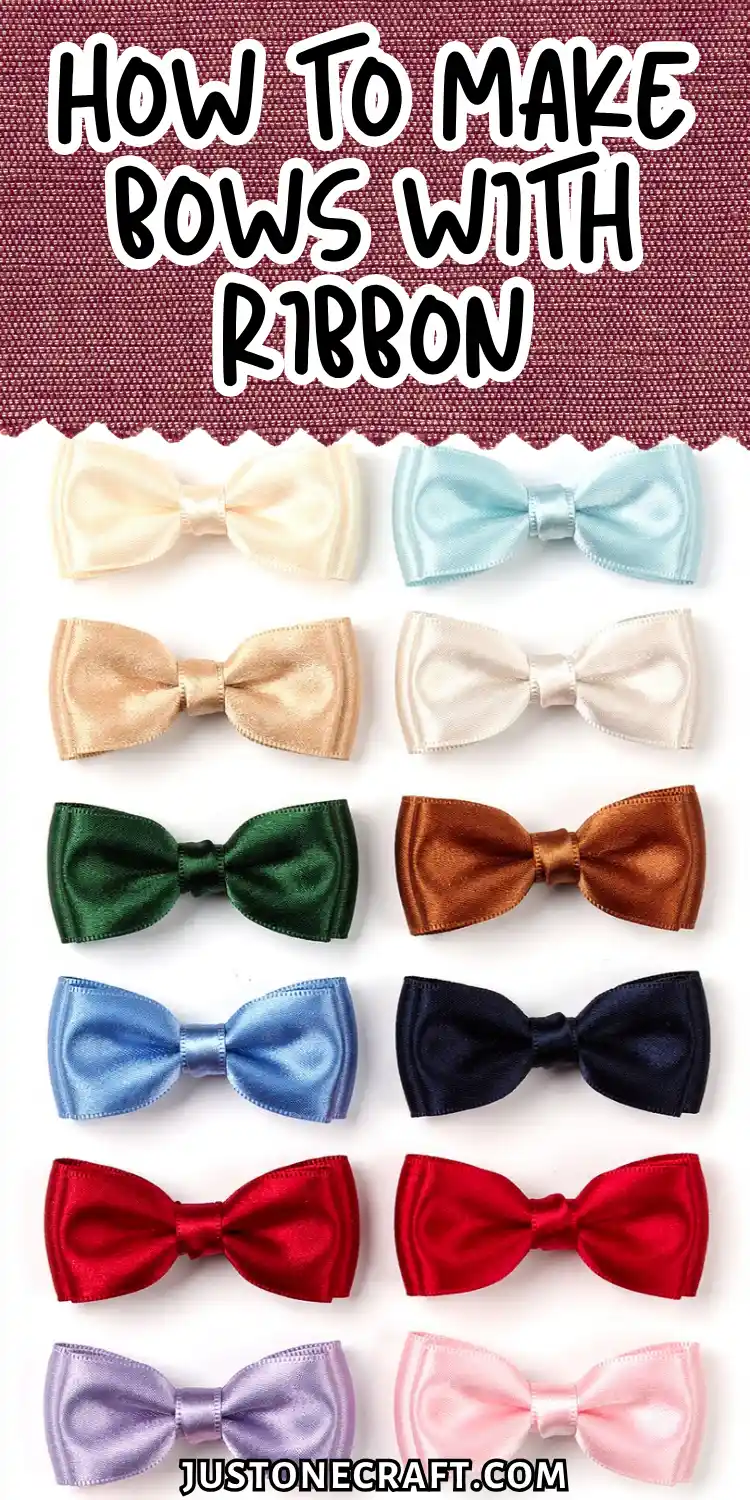
The first time I tried to make bows with ribbon, I thought it would be easy—but my bow turned out uneven and floppy. It was frustrating.
I quickly realized that bow making is simple, but it needs the right technique. Small things, like choosing the right ribbon and making even loops, make a big difference.
Now, it’s one of my favorite DIY skills. A neat bow can instantly upgrade gifts, decor, and crafts—and once you learn it, you’ll use it everywhere.
The Hidden Science of a Well-Formed Bow
Ribbon bows work because of two competing forces: the tension you create by pulling the knot tight, and the stiffness of the ribbon resisting that pull. The knot locks the center; the loops hold their shape because the ribbon’s body pushes outward against its own fold.
This is why wire-edged ribbon makes better bows than limp fabric ribbon — the wire along each selvage (edge) acts like a small spine, letting each loop hold a sculpted curve instead of collapsing flat.
It’s the same reason a stiff cardstock card stands up on a table while a tissue paper card flops. Material stiffness = loop retention.
The other factor is loop symmetry. A bow looks messy not because your technique is bad, but because loops are different lengths or twisted at different angles. The fix is always the same: control your loop size before you pull the knot.
Proportions also matter. A bow looks balanced when each loop is roughly equal to the tail length, and the center knot is no wider than one-third of the total bow width. Stray outside those ratios and the bow reads as accidental rather than intentional.
What you need
Ribbon
Use 1.5-inch or 2.5-inch wired-edge ribbon for your first bow. The wire edge is non-negotiable for beginners — it lets you reshape loops after the fact.
Avoid satin ribbon under 1 inch wide (it slips and twists), and skip grosgrain for your first attempt (it’s stiff but doesn’t hold curves gracefully at small sizes). Brands like Berwick Offray or Lion Ribbon are widely available and consistent in width.
For a standard gift bow, you’ll need approximately 2.5 yards (90 inches) of ribbon.
Floral Wire or Chenille Stems
You need 22-gauge green floral wire, cut into 6-inch pieces. This cinches the center and gives you something to attach the bow to a surface. A chenille stem (pipe cleaner) works as a substitute and is easier for beginners to twist.
Scissors
Sharp fabric scissors only. Craft scissors or kitchen scissors crush the ribbon edge instead of cutting it cleanly, which makes the ends look frayed immediately.
Optional but Highly Recommended: a Ruler or Bow Maker Tool
A bow maker (like the Bowdabra) is a grooved plastic tool that holds your loops at equal length while you tie. It’s not essential, but it removes the most common beginner error — unequal loop sizes — entirely.
Step-By-Step Instructions
1. Measure and Mark Your Tail
Hold the end of the ribbon between your left thumb and forefinger with 8 inches hanging below your hand. This hanging section becomes your first tail.
You should feel the ribbon pinched firmly — not gripped so hard that it crimps, but held securely enough that it won’t slip.
2. Form the First Loop
Bring the ribbon up and over the top of your fingers to create a loop approximately 4 inches long (measured from your pinch point to the top of the loop). Fold it back down so the ribbon crosses itself at your pinch point.
The loop should sit flat, not twisted. If the ribbon face is facing the ceiling on the way up, it should face the ceiling on the way back down — no rotation.
3. Pinch and Hold
Pinch the crossover point between your thumb and forefinger. You’re now holding the tail, the loop, and the crossing ribbon all at one point. This is the hardest part for beginners: keeping that pinch point from drifting. If it slips, the center of your bow won’t hold.
4. Form the Second Loop on the Opposite Side
Bring the ribbon back up and make a mirror-image loop on the opposite side — same 4-inch length, same flat orientation. Bring it back to your pinch point. You now have two loops and one tail, all held at one center point.
5. Repeat for More Loops (Optional)
For a fuller bow, continue making loops — alternating left, right, left, right — until you have 3 to 4 loops per side. Each pair of loops adds volume. Most gift bows use 3 loops per side (6 total). Keep every loop the same length or your finished bow will be lopsided.
6. Cut the Ribbon, Leaving the Second Tail
Leave 8 inches of ribbon for the second tail and cut. You now have a loopy bundle pinched in the center.
7. Secure the Center with Wire
Thread your 6-inch piece of floral wire through the center loop of the bundle, wrap it around the pinch point twice, and twist the ends together firmly behind the bow.
The wire should pull the center tight — you should feel all the loops compress inward slightly at the knot. If the center feels loose, the bow will open up and look sloppy.
8. Separate and Shape the Loops
Pull each loop gently outward and upward, one at a time, rotating the bow as you go. Fan the loops so they fill a full circle rather than sitting in one plane.
With wired ribbon, you can bend each loop to angle forward slightly — this gives the bow dimension and makes it look full from the front. This step takes 60–90 seconds and is entirely what separates a flat bow from a polished one.
9. Trim the Tails
Cut each tail at a 45-degree angle or in a shallow “V” notch (called a chevron cut). A straight horizontal cut looks unfinished. The notch prevents the ends from fraying and adds a professional detail that costs nothing extra.
Storage and aftercare
Store finished bows in a single layer inside a cardboard box, not stacked. Stacking crushes the loops.
If a bow gets squashed in transit, hold it briefly over steam from a kettle — the ribbon relaxes and can be reshaped. Never iron ribbon directly; the heat melts the wired edge or flattens the texture permanently.
Variations
Layered gift topper bow Make two separate 6-loop bows in different ribbon widths (e.g., 2.5-inch and 1.5-inch). Wire them together at the center, with the smaller bow on top rotated 45 degrees. This gives an 8-point star effect without extra complexity.
Fluffy pom-pom bow Use 3-inch wide ribbon and make 10 to 12 loops per side, keeping loops very short — only 2.5 inches. When you fan the loops out, pull each one forward rather than sideways. The result is a dense, rounded bow with almost no visible center.
Single-loop gift accent Cut one 14-inch piece of ribbon. Fold both ends to the center so they overlap by 0.5 inch, pinch the center, and wire. This is a flat, simple single-loop accent — not a full bow, but elegant on small packages or jewelry boxes.
Wreath bow with long streamers Use 4 yards of 2.5-inch ribbon. Follow the standard method but leave 18-inch tails instead of 8-inch. After wiring the center, cut the tails in a long diagonal — one end at 10 inches, one at 18 inches — for a cascading asymmetric look.
Quick Troubleshooting Reference
| Problem | Likely cause | Fix |
|---|---|---|
| Loops won’t hold their shape | Ribbon has no wire edge, or ribbon is too lightweight | Switch to wired-edge ribbon, or stiffen with spray starch before tying |
| Center looks twisted and messy | Pinch point slipped during loop-making | Redo the bow using a bow maker tool to lock the center position |
| Loops are uneven sizes | Loop length wasn’t measured consistently | Use a ruler or mark your finger at 4 inches before starting |
| Bow looks flat from the front | Loops weren’t fanned in 3D | Pull each loop upward and forward, not just to the side |
| Wire is visible at the center | Wire too long or not twisted tightly enough | Trim wire ends to 1 inch before twisting; tuck the twist behind the bow |
| Tails are fraying | Scissors aren’t sharp enough, or ribbon is woven (not wired) | Use sharp fabric scissors; seal woven ribbon edges with a lighter flame held 1 inch away |
One Final Thought
Every bow problem traces back to the pinch point. If the center is held tight, clean, and consistent, the rest is just loop management. When something looks wrong, don’t start over — find the center, rewire it, and reshape the loops. The ribbon isn’t the problem. The knot always is.