How to Make Slime: The Complete Guide That Actually Works

Slime is that satisfying, stretchy, squishy material that’s taken over craft tables everywhere — and for good reason. It’s tactilely addictive, endlessly customizable, and genuinely fun to make.
Most people follow vague instructions and end up with a sticky disaster. This guide gives you the exact ratios, the science behind them, and every fix you’ll need so your first batch of homemade slime comes out perfectly.
What You’re Actually Doing Chemically
Slime is a non-Newtonian fluid created through a polymer cross-linking reaction. PVA glue — the white school glue used in most how to make slime recipes — contains long polymer chains that slide past each other freely.
When you add an activator containing borate ions, those ions bond the chains together through a process called cross-linking, creating a flexible three-dimensional network that traps water.
The result is a material that flows slowly like a liquid when left alone but stretches like a solid when you pull it — a property called viscoelasticity.
This is why ratios matter. Too few borate ions and the chains barely link, leaving you with a sticky mess. Too many and the network becomes over-cross-linked, making the slime snap like rubber.
You are controlling a chemical reaction, not just mixing craft supplies. That mindset shift fixes 90% of beginner mistakes when making slime at home.
Ingredients You Need to Make Slime
For one standard batch — roughly the size of a large orange — gather the following:
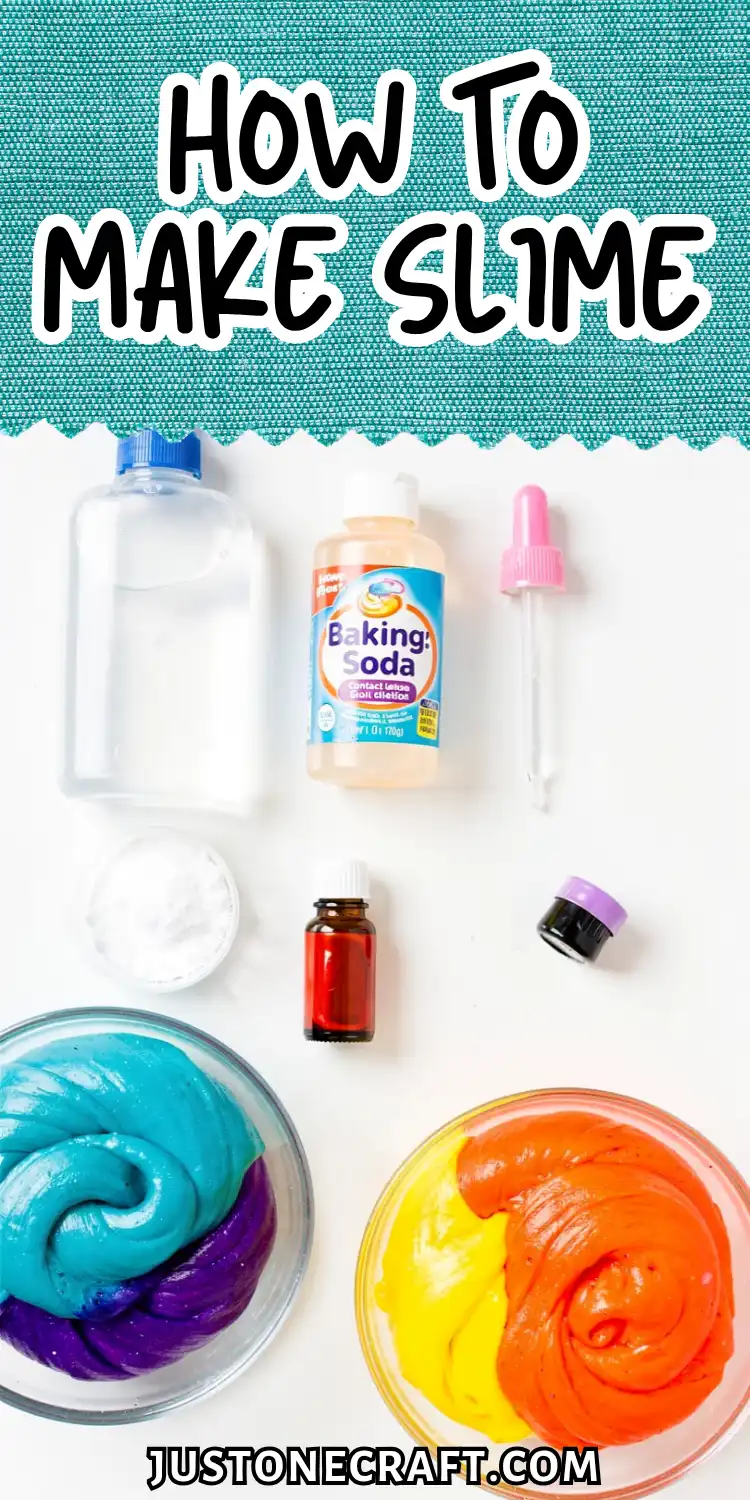
- 1 bottle (4 fl oz) of white PVA school glue: Elmer’s is the most consistent option. Store-brand glues vary in PVA concentration, which throws off how much activator you will need and can ruin your slime recipe.
- Half a teaspoon of baking soda: This is the most skipped ingredient in beginner slime recipes and the one that matters most. It acts as a pH buffer, helping borate cross-links form evenly and significantly reducing stickiness. Do not skip it.
- 1 to 1½ tablespoons of contact lens solution: The label must list boric acid and sodium borate as ingredients — plain saline solution will not activate the slime. Biotrue and Renu Multi-Purpose are both reliable options available at most pharmacies.
- Food coloring or acrylic paint (optional): Two to three drops of gel food coloring gives vivid color without thinning the mixture. A pea-sized squeeze of acrylic paint produces a more opaque, saturated finish.
- Glitter, foam micro-beads, or sequins (optional): These add-ins can be folded in during mixing without interfering with the chemical reaction.
What to avoid: Borax powder works as an activator but is caustic and harder to measure safely, especially with children around. Liquid starch produces a firmer, less elastic slime that tears easily. The contact lens solution method is the safest and most beginner-friendly way to make slime.
How to Make Slime Step by Step
Step 1 — Prepare your glue base. Pour the entire 4 oz bottle of glue into a bowl. Add 2–3 drops of food coloring or a pea-sized squeeze of acrylic paint. Stir until fully mixed. If you want glitter slime, add it now — about 1 tbsp per batch.
Step 2 — Add baking soda. Add ½ tsp baking soda to the colored glue and stir well. This step is often skipped in simplified recipes, but it’s what gives the slime structure and reduces stickiness. Don’t skip it.
Step 3 — Add activator slowly. Add contact lens solution one teaspoon at a time, stirring between each addition. You’ll see the slime begin pulling away from the bowl sides. Once it forms a ball and stops sticking to your hands (usually at 1–1.5 tbsp total), stop adding solution.
Step 4 — Knead with your hands. Take the slime out of the bowl and knead it for 2–3 minutes. It will feel sticky at first — that’s normal. Keep kneading. It smooths out as the polymer chains align.
Step 5 — Test and adjust. Stretch a piece between your fingers. It should stretch at least 6–8 inches without snapping. If it tears quickly, add ½ tsp more contact solution. If it’s too rubbery, add a tiny drop of lotion and knead it in.
How to Store Homemade Slime
Slime dries out as it loses the water trapped in its polymer network. Store it in an airtight zip-lock bag or lidded jar at room temperature.
Do not refrigerate your slime — cold temperatures stiffen the polymer network and the texture rarely recovers fully.
Properly stored slime lasts 1 to 2 weeks. If it gets sticky after a few days, knead in 3 to 5 drops of contact lens solution to reactivate the cross-links and restore the stretch.
Slime Variations to Try Next
Once you have mastered the basic slime recipe, these popular variations are all built on the same foundation.
Fluffy Slime: Replace 2 oz of glue with white shaving cream. The air bubbles in the cream roughly double the volume and create a soft, cloud-like texture that is more satisfying to poke and squeeze. Expect to use slightly more contact lens solution since the shaving cream dilutes the glue concentration.
Butter Slime: Knead 2 tablespoons of soft modeling clay — Daiso or Crayola Model Magic both work well — into finished basic slime over 4 to 5 minutes. The result is a matte, spreadable slime with a texture somewhere between slime and putty, and it is particularly satisfying to press and smooth flat.
Clear Slime: Use clear PVA school glue with the exact same ratios as the basic recipe. Fresh clear slime will look completely cloudy due to air bubbles from mixing. Seal it in an airtight container and leave it untouched for 3 to 5 days. The bubbles slowly rise out on their own, leaving you with glass-like transparent slime that is worth every minute of the wait.
Quick Troubleshooting Reference
| Problem | Likely Cause | Fix |
|---|---|---|
| Too sticky | Not enough activator, or not kneaded long enough | Knead 2 more min; then add ¼ tsp contact solution |
| Snaps/tears | Over-activated | Add warm water or lotion, knead in |
| Rubbery, stiff | Too much activator | Add water drops, knead thoroughly |
| Stringy, not forming a ball | Too little activator | Add ½ tsp contact solution and stir |
| Dull/cloudy (clear slime) | Air bubbles | Rest sealed in container for 3–5 days |
| Dried out after storage | Exposed to air | Knead in a few drops of warm water |
Final Tip
Once you understand that making slime means calibrating a cross-linking reaction rather than blindly following a recipe, troubleshooting becomes intuitive. Every batch teaches you something about the ratios. Within two or three tries, you will be adjusting by feel — and getting consistently perfect, stretchy, satisfying slime every single time.