How to Make Kandi

Kandi are handmade beaded bracelets exchanged as tokens of friendship and connection, most famously at raves, music festivals, and EDM events. They’re woven from plastic pony beads on stretchy cord — simple in construction, but the trade carries genuine cultural weight in the rave community.
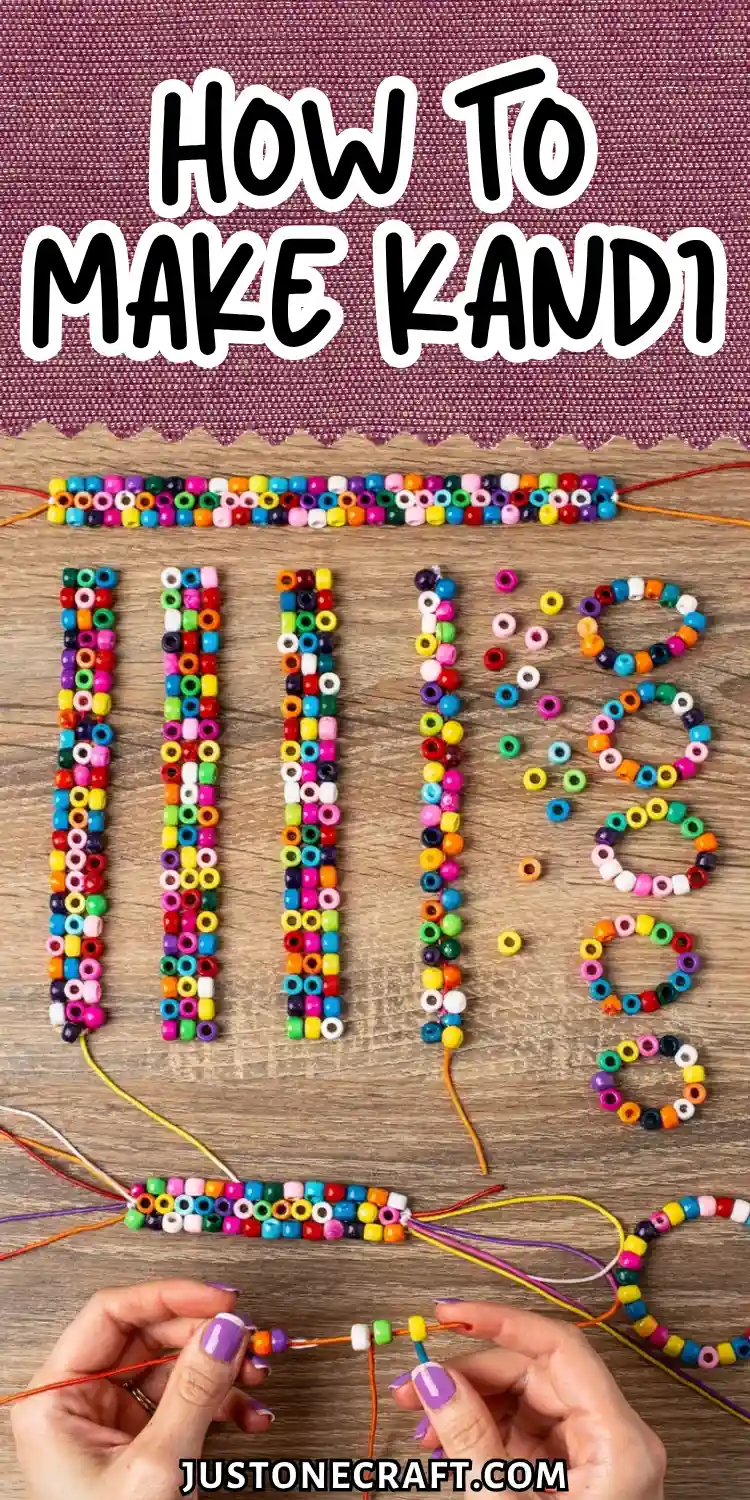
Why the Weave Actually Holds (The Logic Behind It)
A kandi bracelet is made by threading beads onto elastic cord. The beads keep the bracelet’s shape, while the elastic provides flexibility and evenly distributes tension.
For better durability, hide the knot inside a bead, as it protects the knot from wear and helps the bracelet last longer.
What You Need
Pony beads Use 6×9mm plastic pony beads — the standard size stocked at any craft store (Perler, Darice, and Creatology are all fine). Avoid jumbo beads (too heavy, bracelet sags) and seed beads (too small for the cord, and nearly impossible to restring).
Elastic cord 0.5mm clear elastic is the sweet spot. Thinner than that snaps after a few wears. Thicker than 0.7mm won’t thread through standard pony bead holes cleanly. Beadalon and Stretch Magic are reliable brands. Avoid sewing elastic thread — it frays and isn’t strong enough.
Scissors Any sharp pair. You need a clean cut, not a frayed end that won’t thread through a bead.
Clear nail polish or fabric glue (commonly skipped — don’t) This seals your finished knot. Without it, the knot loosens over time from the stretching motion. One drop of clear polish or a tiny dab of fabric glue makes the difference between a bracelet that lasts a festival and one that falls apart by midnight.
A clasp or big safety pin (optional but useful) Clip one end of your cord to a safety pin and pin it to your jeans or a pillow while you bead. Keeps the cord from slipping through as you work.
Step-By-Step Instructions
1. Cut your cord Cut a piece of elastic 12 inches (30cm) long. This gives you enough to work with comfortably and leaves cord for knotting. Don’t cut shorter to save material — you’ll run out of cord before you can tie a secure knot.
2. Secure one end Tie a temporary overhand knot at one end, or clip it with a safety pin. You should have a stable anchor — if you skip this, beads slide off the other end while you’re working.
3. String your beads Thread beads onto the cord one at a time in your chosen pattern. For a standard adult wrist, you need approximately 20–24 beads to complete a bracelet. String 22 as your baseline, then test it around your wrist before knotting. The bracelet should fit snugly but slide over your knuckles without forcing.
What you’ll notice: a full bracelet of 22 beads will look too small lying flat on a table — this is correct. Elastic contracts when not stretched, so it always looks shorter than it feels on the wrist.
4. Remove the temporary knot and tie off Undo your anchor knot or unclip the pin. Bring both cord ends together and tie a surgeon’s knot: cross right over left, pull through twice, then cross left over right and pull through once. This is stronger than a standard overhand knot and resists loosening under repeated stretch.
The most common beginner mistake: tying only a single overhand knot. It slides open within a day of wearing.
5. Pull the knot inside a bead Tug both cord ends gently while pushing the knot toward the nearest bead hole. With a little pressure, the knot seats itself inside the bead cavity, hidden from view and shielded from friction. You should feel a small “pop” as it tucks in.
6. Seal the knot Apply one small drop of clear nail polish directly onto the knot (even if it’s tucked into a bead). Let it dry fully — about 60 seconds for most nail polish formulas. Trim any cord tail to 2–3mm, not flush — cutting too close risks nicking the knot itself.
Aftercare
Pony bead kandi is water-resistant but not waterproof. Prolonged soaking (pools, showers) weakens the elastic faster than anything else. Pat dry if it gets wet, and store bracelets loosely — not coiled tightly — to avoid stressing the cord over time.
Faded beads can’t be restored, but a broken bracelet can always be restrung onto fresh cord in under 5 minutes.
Variations
Word kandi Use letter beads (same 6×9mm format, widely available) to spell a name, phrase, or affirmation. Most builders place the word centered on the bracelet with a single color flanking each side. Read the letters as you string — it’s easier to catch a backwards letter before it’s knotted in.
Multi-strand bracelets String two or three parallel strands and knot them onto a single clasp on each side. Each strand is built identically to a single bracelet; the clasp is what distinguishes this from stacking individual pieces.
Peyote stitch cuffs The structural upgrade. Instead of a single strand, peyote stitch interlocks beads in an offset grid pattern, creating a flat, wide cuff. It uses the same beads and cord but requires threading through beads twice — once during the initial row, once during the return pass. The result is rigid enough to hold a pattern or image across the surface.
3D shapes (perlers) Using a pegboard and iron-melt beads (Perler/Hama), you can create geometric 3D kandi shapes — stars, cubes, hearts — that attach to bracelets or stack into full kandi cuffs. These aren’t strung; they’re fused with heat and connected by short cord links.
Troubleshooting
| Problem | Likely cause | Fix |
|---|---|---|
| Bracelet snaps after a few wears | Cord too thin or single knot used | Switch to 0.5mm cord, use surgeon’s knot, seal with polish |
| Knot keeps slipping out | Knot not sealed, bead hole too large | Seal with nail polish; try double-knotting before seating |
| Bracelet too tight or too loose | Wrong bead count for wrist size | Test-fit before knotting; add or remove 2 beads at a time |
| Cord won’t thread through bead | Cord too thick or end is frayed | Trim end at a sharp angle; use 0.5mm cord |
| Pattern looks wrong when worn | Strung in wrong order | Lay out your full pattern flat before stringing |
| Beads slide unevenly | Tension inconsistent while stringing | Work on a flat surface; pin the anchor end |
One Final Thought
Every kandi problem is a tension problem. Too tight, too loose, knot that slips, bracelet that snaps — they all trace back to how the cord is managing force across the piece.
Once you internalize that, you can diagnose any issue you run into without needing to look it up. The bead is just a spacer. The cord is doing all the work.