30 Autumn Table Runner Sewing Ideas to Fill Your Fall With Fabric

There’s a certain kind of fall project that starts with one fat quarter and ends up taking over your whole sewing table, and autumn table runner sewing tends to do exactly that.
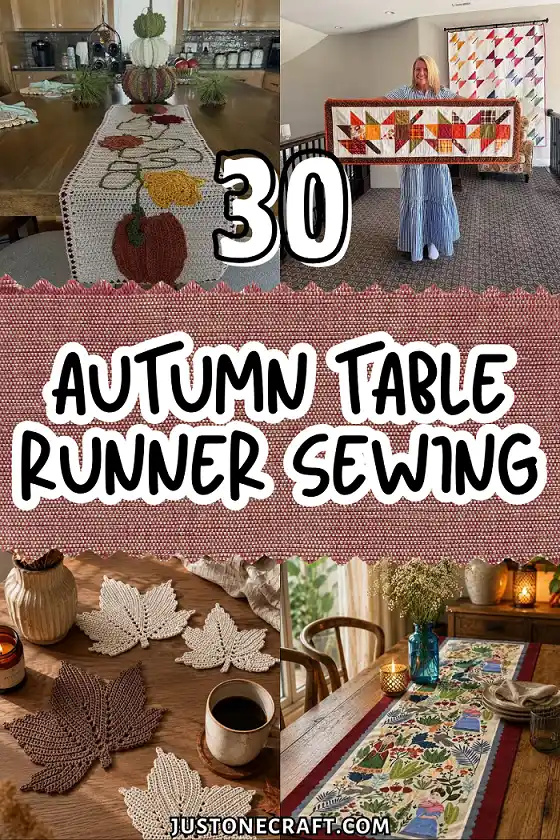
This list pulls together thirty of them, and no two look alike. Some are pieced patchwork with pumpkins and leaf blocks, others are crochet, embroidered linen, or simple hemmed plaid you can finish in an afternoon.
A few lean traditional with reds and browns, and a few skip orange completely for sage, plum, or dusty rose instead.
Whether you’ve got a stack of scraps waiting for a purpose or you’re starting from nothing but a bolt of fabric, one of these is probably the project your table has been waiting for.
Grab your machine, a hook, or a needle, and take your pick.
1. A Scrappy Leaf Block Runner That Turns Fat Quarters Into Fall Magic
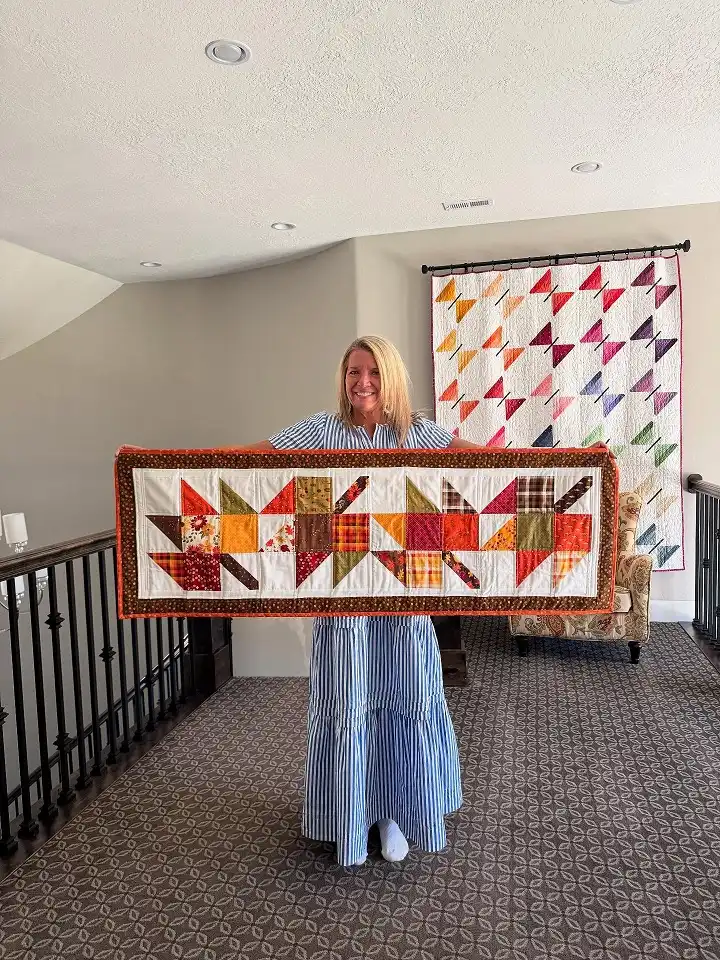
Nothing turns a stack of fat quarters into fall décor faster than a leaf block runner like this one.
The maker mixed plaids, tiny florals, and solids inside a pieced leaf shape pattern, then framed the whole thing in a warm brown print border with an orange binding peeking through.
What stands out:
- Every leaf block uses different fabric, so no two look alike
- A dark border makes the warm colors pop instead of blending together
- The binding color repeats one of the fabrics inside the blocks, tying it all together
If your scrap bin is bursting with autumn prints, this is the pattern that finally uses them up.
A scrappy leaf block hides fabric mismatches better than almost any other autumn pattern.
2. The Burlap and Pom-Pom Runner That Makes Plain Wood Tables Feel Like Autumn
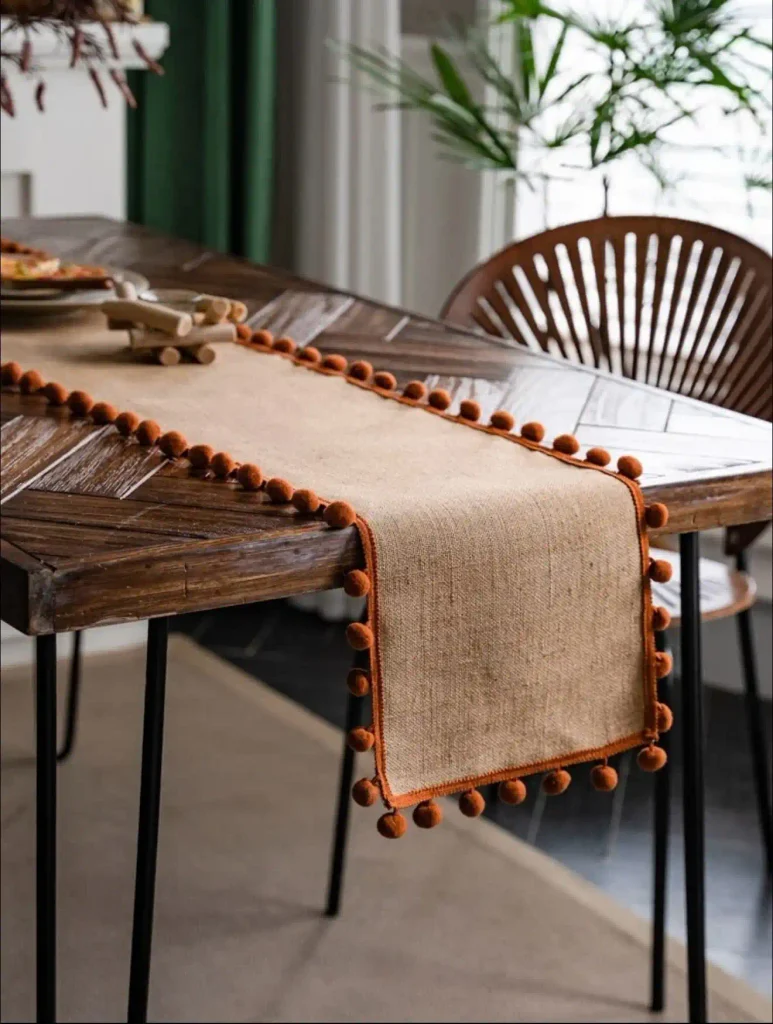
Burlap gets a soft season upgrade the moment pom-pom trim shows up along the edge.
This one keeps things simple: natural woven linen down the center, a solid rust border, and a full row of chunky felt pom-poms stitched all the way around.
The texture contrast is what makes it work. Rough burlap next to soft rounded pom-poms gives your eye somewhere to land, even on a table that’s otherwise plain.
Recreate this look
3. A Botanical Print Runner With a Folk Art Twist for Your Fall Table
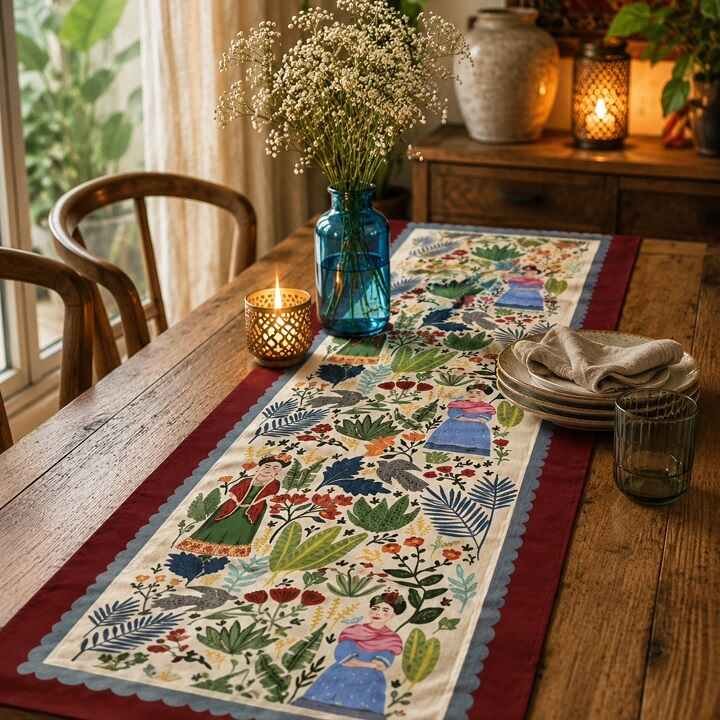
Folk art figures wandering through leaves and ferns give this runner a story to tell instead of just a color scheme.
Dense botanical shapes in blue, green, and rust cover a cream base, framed by a deep red border and a scalloped blue edge.
This one isn’t a traditional pumpkin-and-plaid autumn piece, and that’s exactly the appeal.
It leans into pattern the way a favorite tablecloth from a market stall might, mixing figures, foliage, and small creatures across the whole panel.
A runner this pattern heavy pairs best with plain plates and simple napkins so the design stays the centerpiece.
4. A Playful Pumpkin Patch Runner With a Black Cat Hiding in the Vines
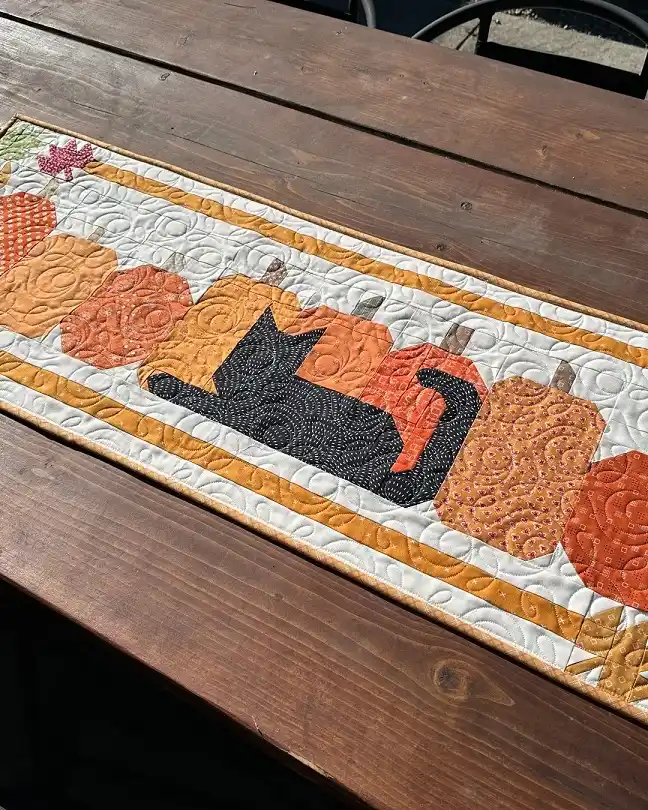
Somewhere in this pumpkin patch sits a sleepy black cat, and that small surprise is the whole charm.
A row of orange and gold pumpkins in different prints stretches across a cream background, quilted with a swirling pattern that echoes the vines, all bordered in a warm mustard binding.
The cat block is the same size as the pumpkins, so it slots right into the row without breaking the rhythm.
💡 Quick Tip
Swap one pumpkin block for a same-sized surprise shape, like a cat or a leaf, to give a repeating pattern a wink of personality.
Little touches like this are why a repeated block pattern still feels fresh from end to end.
5. Two Ways to Style the Same Crow and Pumpkin Runner Pattern
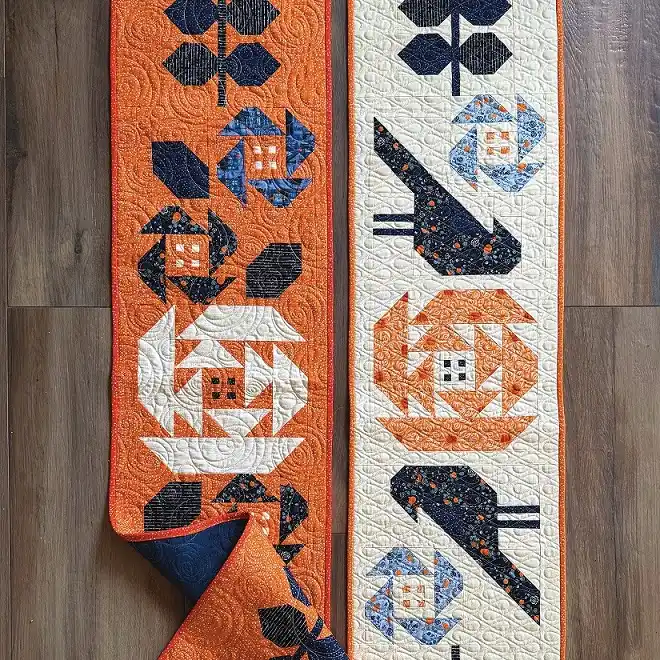
Same pattern, two totally different moods, depending on which background fabric leads.
Both runners use identical pieced crow and pumpkin blocks in navy, orange, and cream, but one sets those blocks on a solid orange background and the other flips to cream.
| Orange Background | Cream Background |
|---|---|
| Bold and self-sufficient on a plain table | Softer, easy to mix with other prints |
| Best with minimal extra decor | Best with mismatched or vintage place settings |
If you’re only making one runner, let your table’s current colors decide which background wins.
6. A Crochet Lace Runner With Beaded Tassels for a Softer Kind of Fall
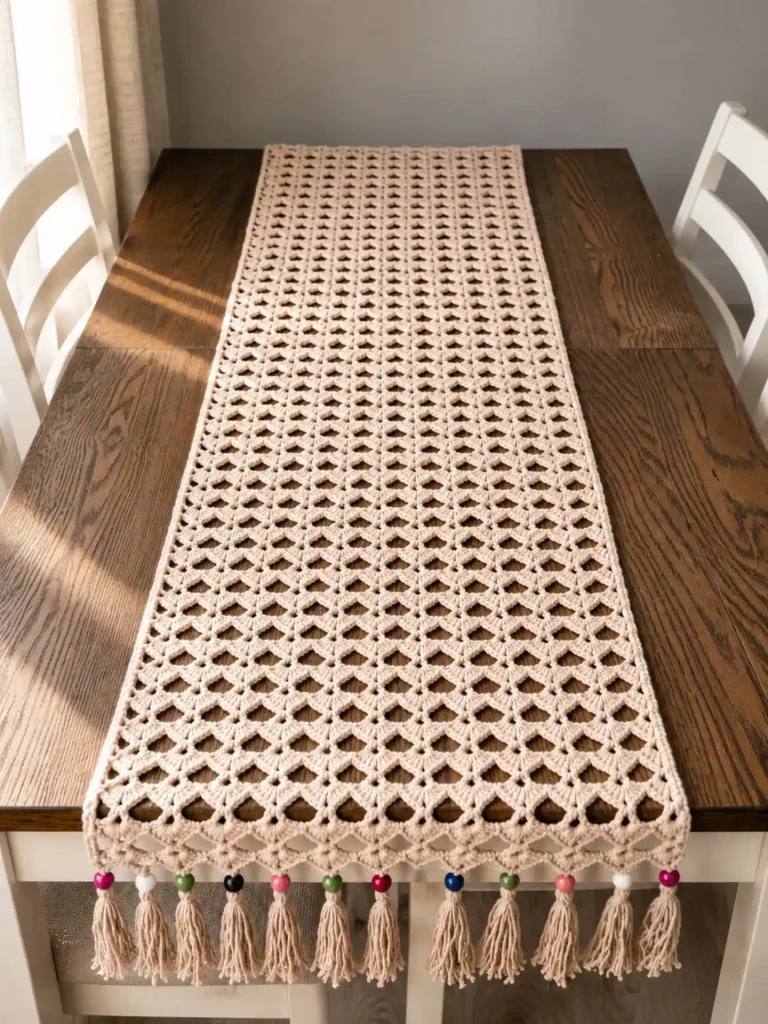
Crochet hooks earn a spot at the fall table with a lace runner this delicate. An open, diamond stitch pattern runs the full length in a soft neutral yarn, finishing in a row of tassels, each one weighted with a small painted wood bead in a different color.
The beads are what elevate this from a basic crochet strip to something that reads as finished décor.
They add a bit of unexpected color without touching the yarn itself, so the runner still looks calm and neutral from a distance.
Not sure the diamond stitch is beginner friendly? A simpler filet crochet grid gives a similar open, airy look with fewer stitch counts to track.
Keep the yarn neutral so beads carry the color.
Vary bead colors for a handmade, unmatched look.
Loud multicolor yarn plus loud beads at once.
Tassels so long they drag off the table.
7. A Modern Black Cat Runner That Works All Autumn, Not Just Halloween
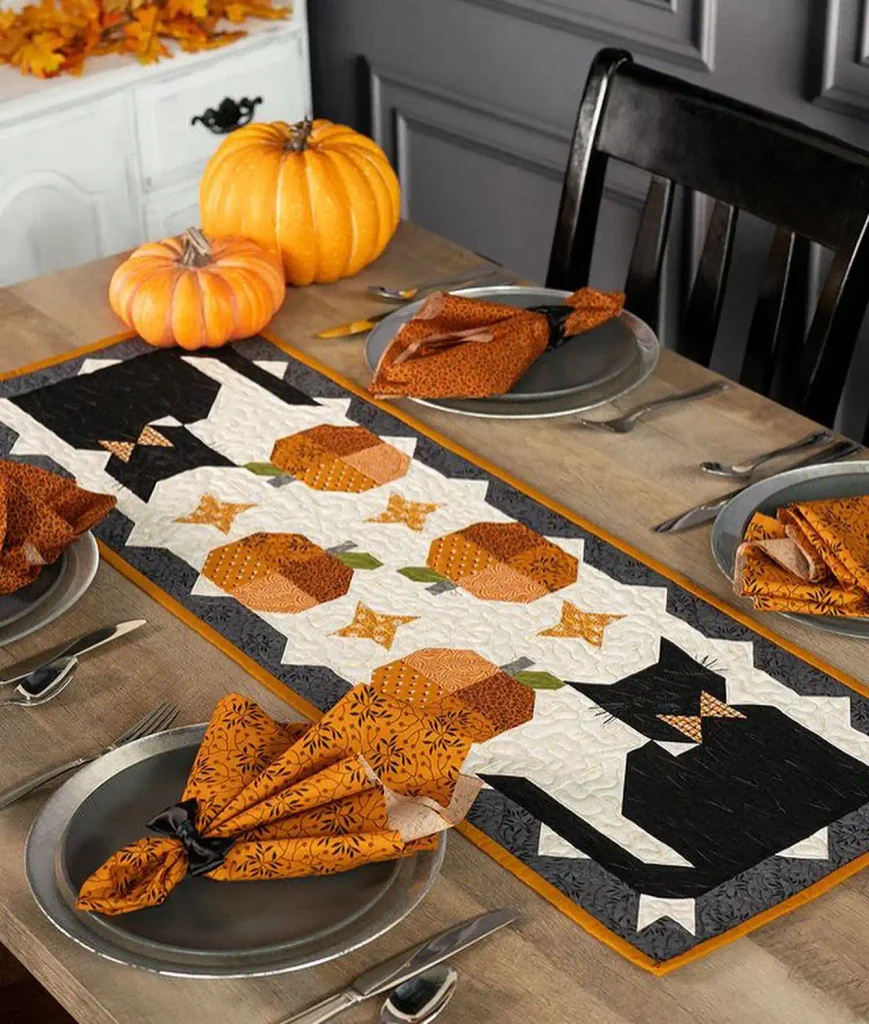
Halloween black meets everyday cream in a cat silhouette runner built to last past October.
Two graphic black cat shapes bookend a row of pieced pumpkins and small stars, all set against sharp geometric cream and charcoal backgrounds with a mustard gold binding.
What works here: the cat shapes are simple and solid, almost like paper cutouts, which keeps the piece from feeling costume-y.
Pair it with warm gold napkins instead of orange and black, and it slides easily from Halloween right into general fall decorating.
8. An Appliqued Leaf Placemat Shape You Can Turn Into a Mini Runner
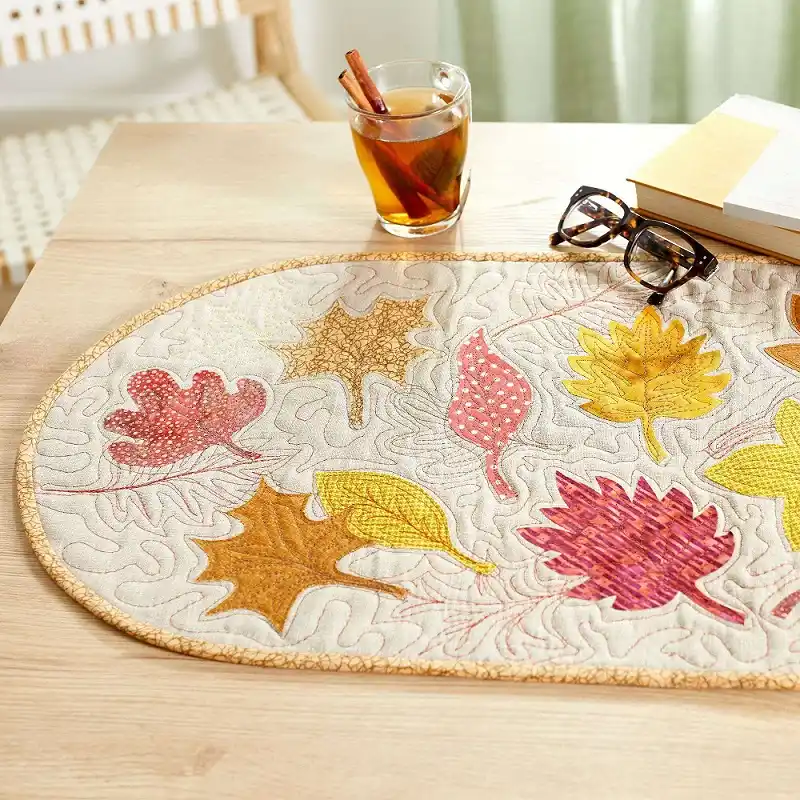
Oval leaf placemats hide a runner idea most sewists overlook.
This piece scatters appliqued leaf shapes, oak, maple, and simple pointed leaves, across a cream oval, each one finished with matching thread outline quilting that adds a hand-drawn texture underneath the fabric.
To turn a single placemat shape into a full table runner:
- Extend the oval into a long stretched shape, or piece two ovals with a straight center panel
- Repeat the leaf shapes at different scales so no two rows match
- Match your outline quilting thread color to each leaf instead of using one thread throughout
This same scattered leaf layout also works beautifully shrunk down for a set of coordinating placemats.
9. A Classic Nine-Patch Runner That Lets Your Pumpkin Prints Shine
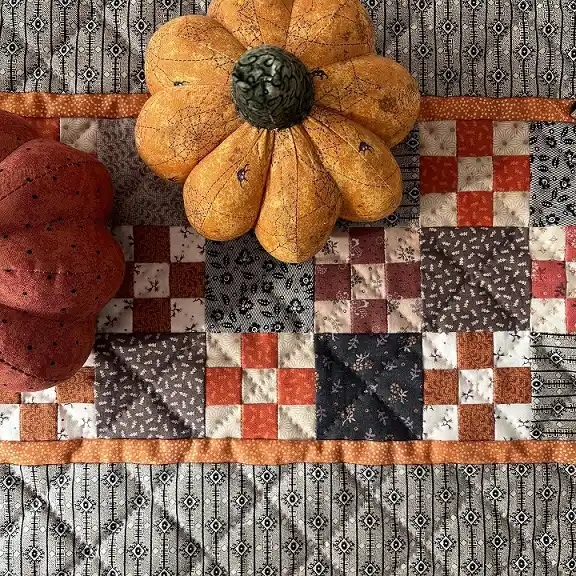
Charm squares find real purpose in a nine-patch runner planned around a single pumpkin print.
Rust, cream, and charcoal fabrics rotate through a simple checkerboard nine-patch grid, framed by a dotted orange border, with a soft fabric pumpkin resting on top as styling.
Charm squares tossed together with no color plan.
A rotating nine-patch grid with dark, medium, and light values placed on purpose.
The trick here is placement, not fabric choice. Even ordinary prints look intentional once dark, medium, and light values rotate in a predictable pattern across the grid.
10. Crochet Maple Leaves You Can Join Into a No-Sew Table Runner
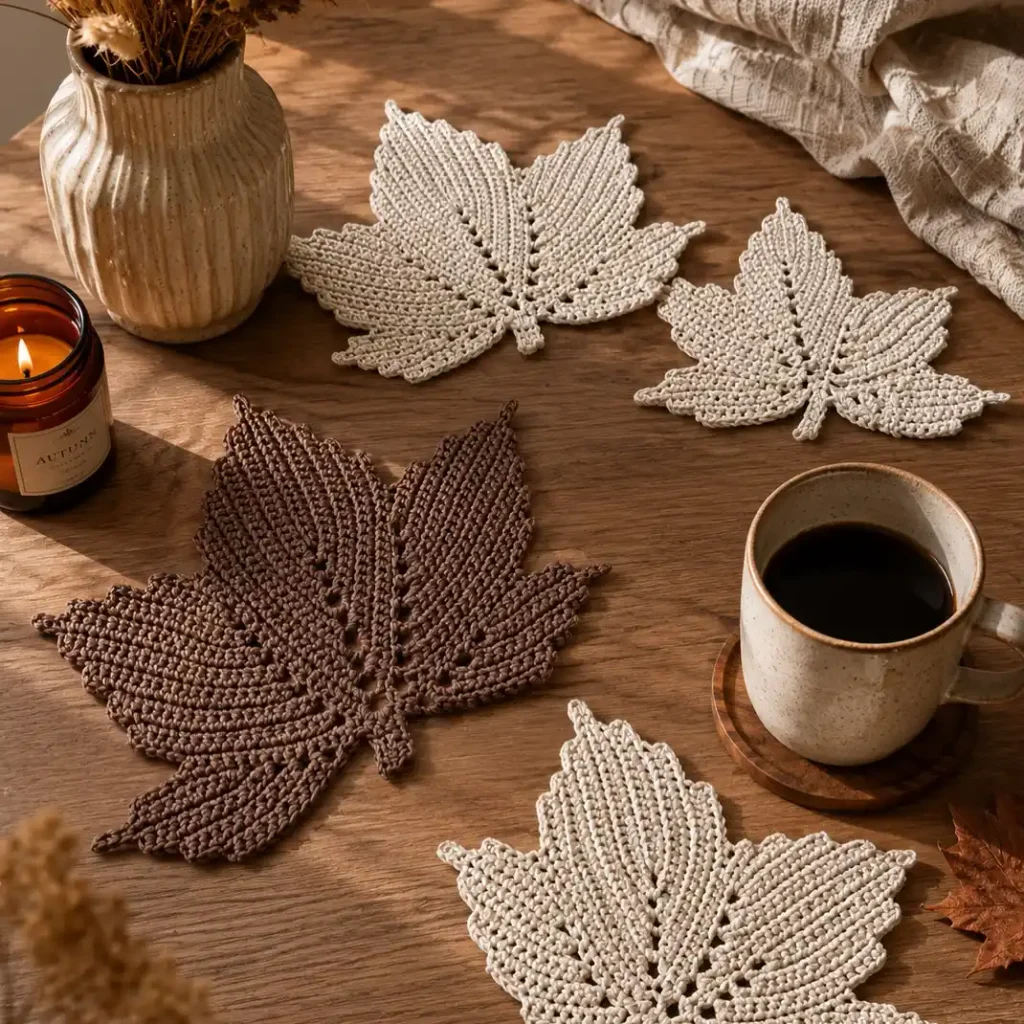
Maple leaves made entirely of crochet stitches skip the sewing machine altogether.
Each leaf is worked flat in a single color, cream or soft brown, with visible ridged texture along the veins and pointed tips that mimic a real maple leaf’s shape.
Laid loosely on a table as shown, they work as oversized coasters. Joined edge to edge with a simple slip stitch seam, that same leaf motif becomes a full table runner with almost no straight lines in it at all.
- Work each leaf the same size so they join evenly
- Use two related yarn shades for gentle contrast, not one flat color
- Join along the widest part of each leaf so the seam barely shows
11. A Plaid and Polka Dot Leaf Print Runner for an Easy Weeknight Sew
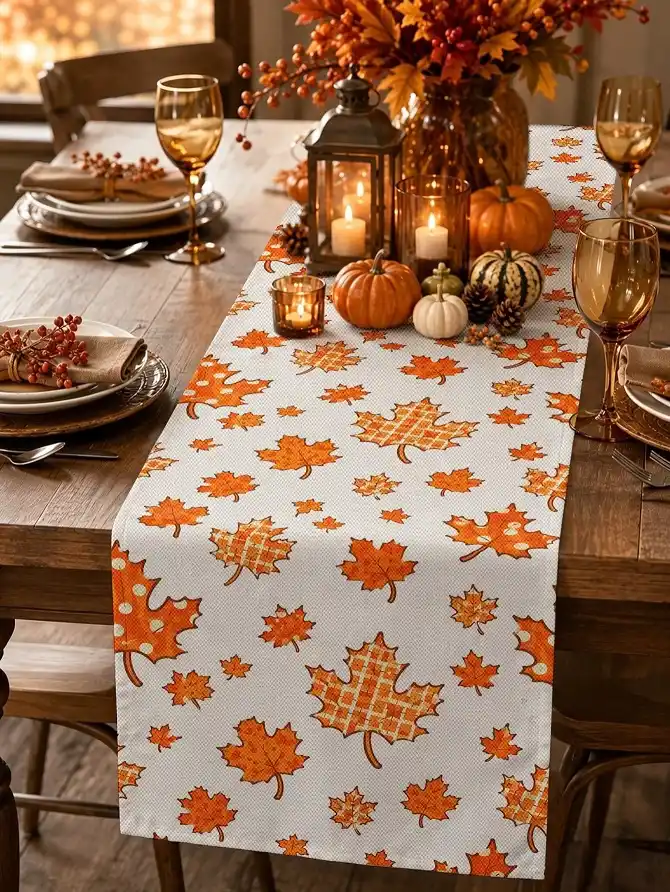
Plaid leaves and polka dot leaves share the same vine on this printed panel. Large and small maple leaf shapes scatter across a plain woven background, each printed with its own tiny pattern instead of a solid color, so the whole runner reads busy but organized.
Quick specifics:
- The printed fabric does all the design work, so construction is just hemming a rectangle
- Mixing leaf sizes keeps a repeating print from feeling too uniform
- A tight weave background fabric helps the printed pattern stay crisp
This is the entry to hand a beginner who wants an autumn runner without touching piecing or appliqué.
Let a printed fabric do the pattern work, and construction stays as simple as hemming a rectangle.
12. A Black and Orange Crochet Runner With Flowers Bold Enough for Halloween
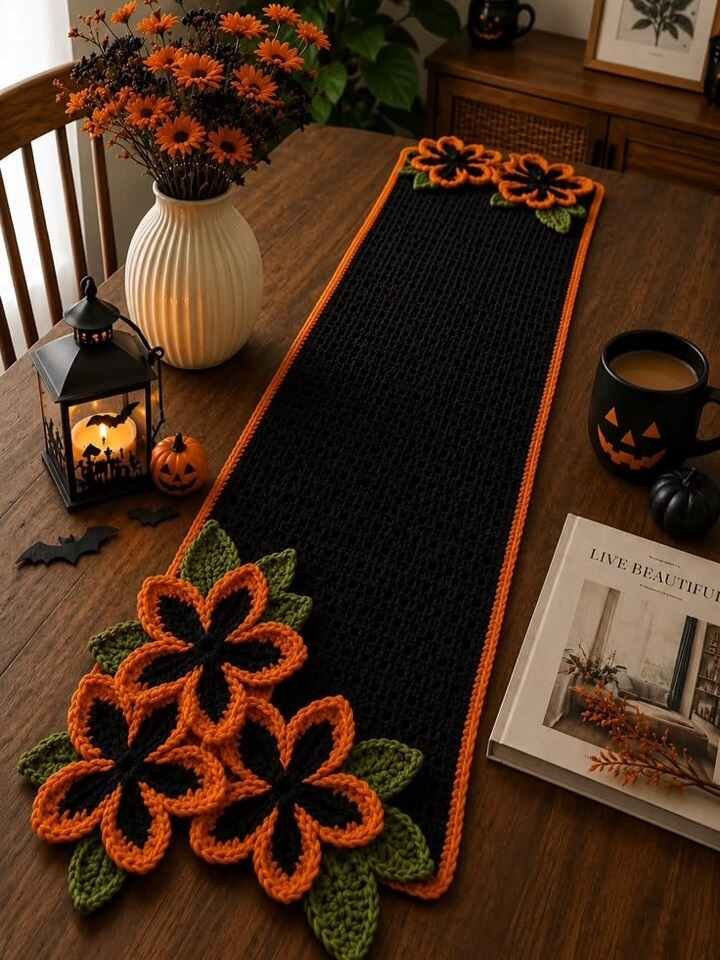
Halloween crochet rarely looks this polished, and the secret is restraint. A solid black textured base runner gets a bright orange crochet trim, then one corner blooms with layered orange and black crochet flowers surrounded by simple green leaves.
Keeping the flowers to one corner instead of scattering them across the whole runner is what stops this from tipping into costume territory.
The black base does the heavy lifting, and the flowers stay as an accent, not the main event.
Recreate this look
13. A Sage and Gold Patchwork Runner With Embroidered Pumpkin Squares
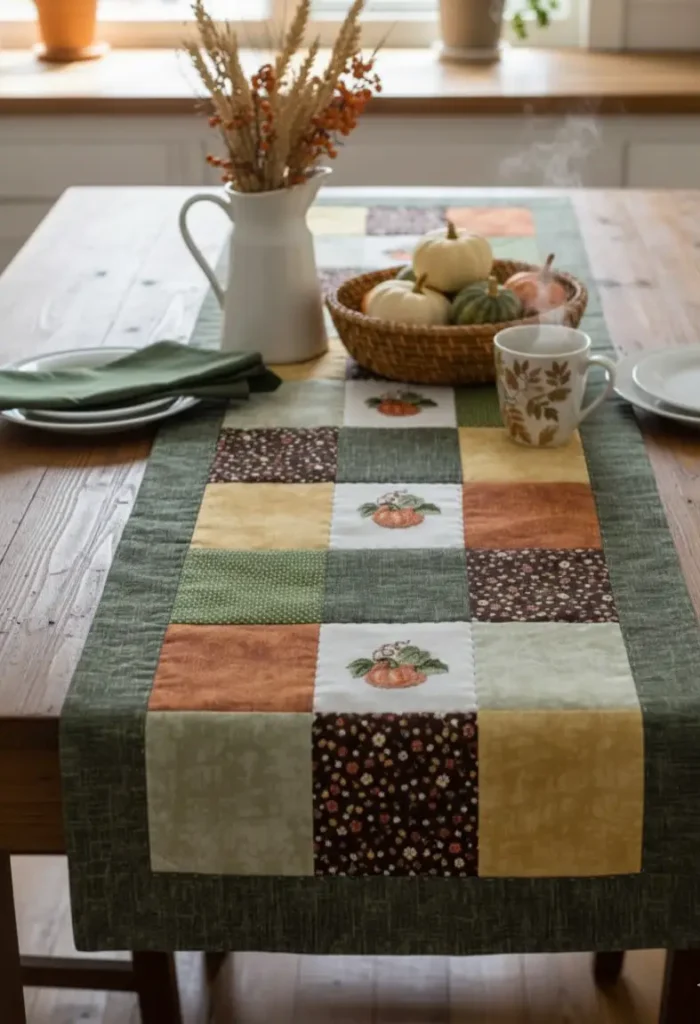
Sage green squares hold space for a single embroidered pumpkin, repeated just enough to feel intentional.
This runner rotates sage, gold, rust, and small floral prints through a simple block grid, with three cream squares carrying a small embroidered pumpkin motif spaced evenly down the length.
The green background is what sets this apart from the usual orange-heavy autumn runner.
It reads more farmhouse kitchen than Halloween table, and works well left out well past pumpkin season into early winter.
14. A Column of Crochet Flowers and Leaves Instead of One Long Runner
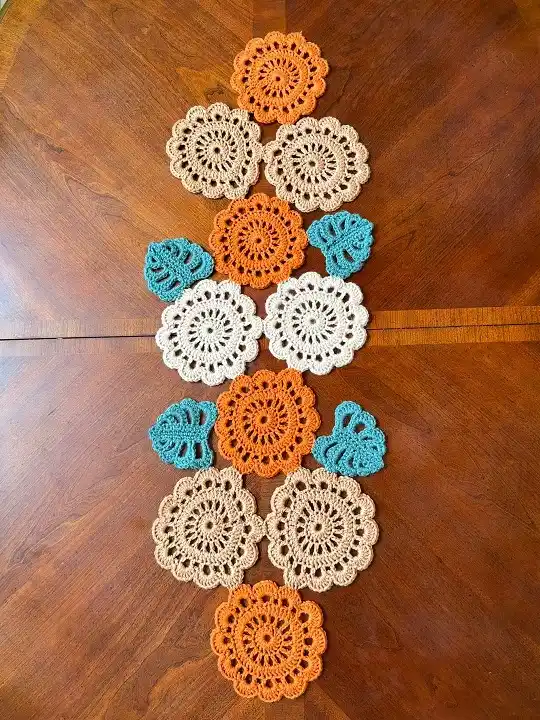
Round crochet motifs stacked in a column replace the usual long rectangle runner shape.
Layered rounds in orange, tan, and cream, worked in a flower-like scalloped stitch, join down the center of the table, with small teal crochet leaves tucked between them for contrast.
This is less a runner in the traditional sense and more a garland laid flat. The teal leaves are the detail worth stealing, since a small pop of an unexpected color keeps an all-warm palette from feeling one-note.
💡 Quick Tip
Add one small motif in an unexpected color, like teal against orange, to keep an all-warm palette from feeling flat.
15. A Scrap-Basket Patchwork Runner That Uses Every Fall Fabric You Own
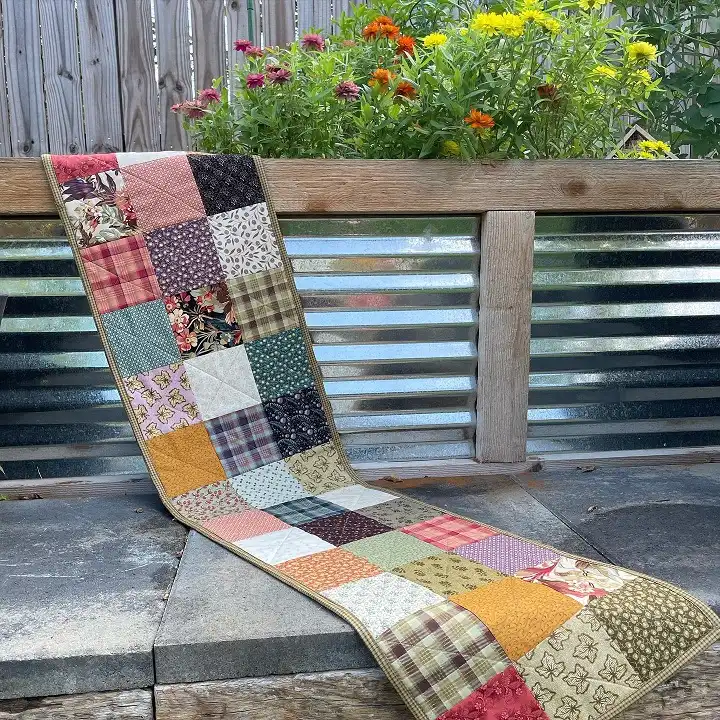
Every leftover fall fat quarter in the sewing room seems to have landed on this one runner.
Dozens of different squares, plaids, tiny florals, ditsy prints, and solids in rust, olive, plum, and gold, are pieced edge to edge with a simple tan gingham binding holding the whole thing together.
Let a few fabrics repeat for visual rhythm.
Bind in a neutral so scraps stay the focus.
Forcing every square to be unique with no repeats.
A bold binding that competes with the patchwork.
A runner like this is really a fabric journal. It works best when you genuinely can’t remember where half the prints came from.
16. A Maple Leaf Runner in Soft Rose and Plum for a Gentler Kind of Fall
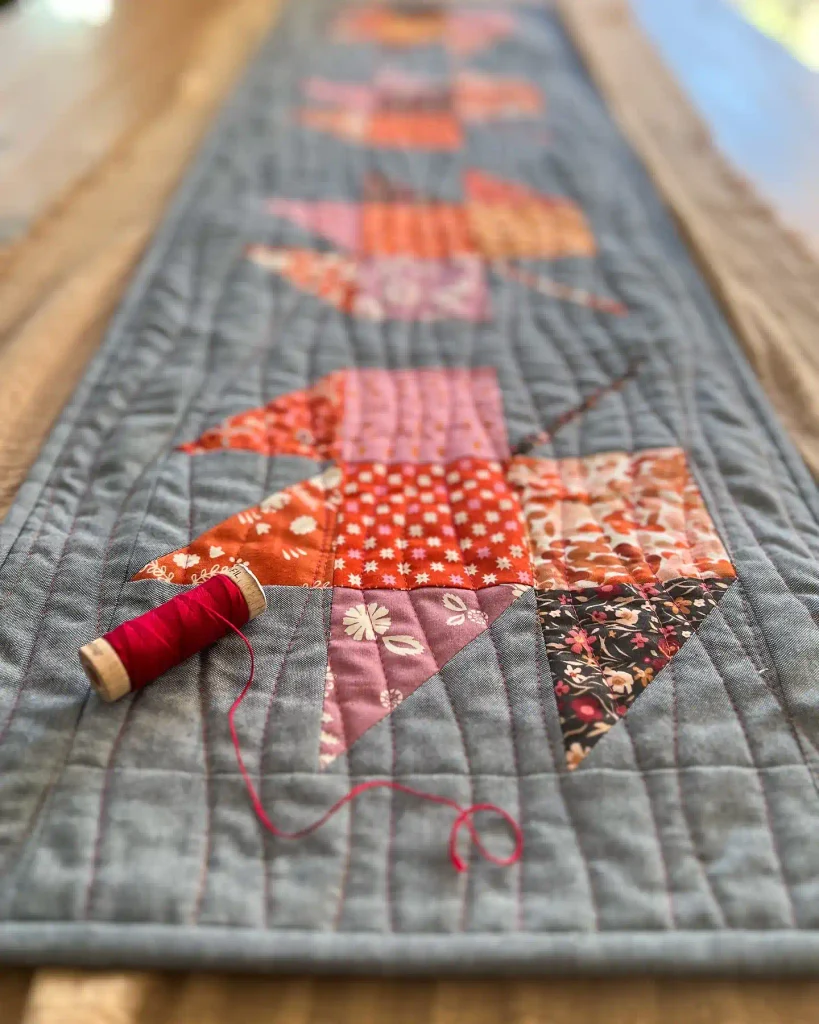
Fall décor doesn’t have to mean orange and brown. This pieced leaf block runner swaps the usual pumpkin palette for dusty rose, plum, and soft floral prints, set against a cool gray background with visible straight line quilting running the length of the piece.
A spool of red thread left resting on top hints at just how much hand finishing went into it.
Three things worth noticing:
- Cool gray background instead of cream or white shifts the whole mood
- Straight line quilting adds texture without competing with the busy leaf prints
- Rose and plum fabrics make this work for fall decorating that leans feminine, not rustic
Anyone tired of orange everywhere in October will want to bookmark this one.
💡 Quick Tip
Swap your background fabric to gray or dusty blue if you want autumn colors without the usual orange overload.
17. Watch a Single Vine Turn a Plain Crochet Runner Into a Pumpkin Patch
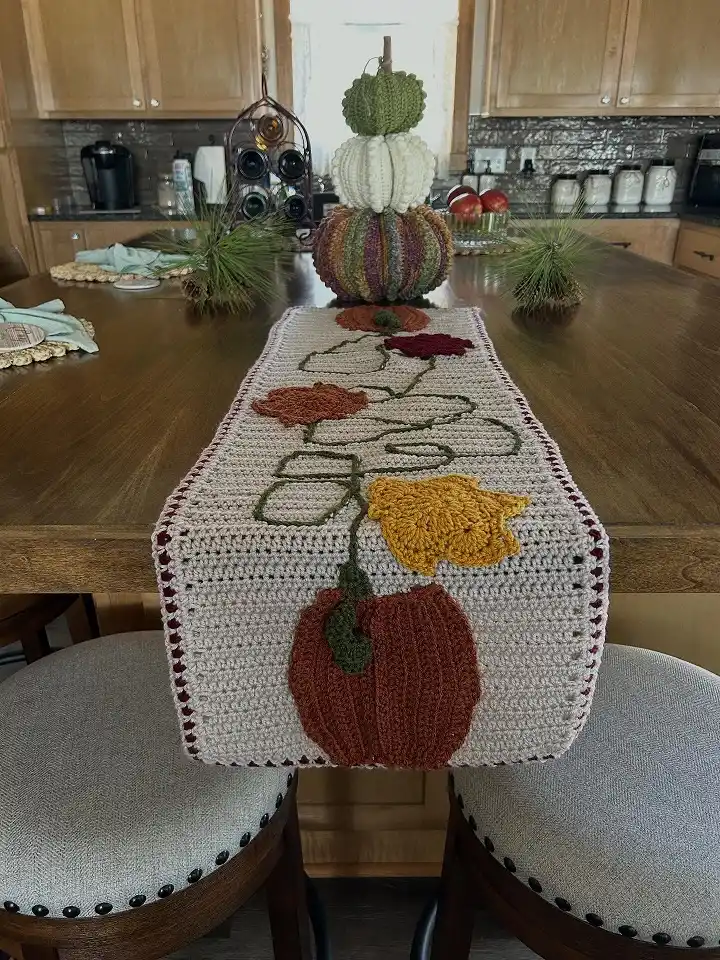
A crochet vine climbs the entire length of this runner, connecting one crochet pumpkin at the bottom to four different flower motifs along the way, all worked in warm mustard, burgundy, rust, and olive yarn.
The base itself stays a simple solid stitch in oatmeal, so the vine design gets to be the whole show.
How to recreate it:
- Work a plain solid-stitch base runner first, no pattern needed
- Chain or slip stitch a winding vine shape freehand across the surface
- Attach separate crochet flower and leaf motifs along the vine at uneven intervals
- Finish with one larger pumpkin motif anchoring one end
A styled pumpkin stack behind it shows how well handmade crochet pumpkins photograph next to a runner in the same yarn family.
18. Triangle Patchwork Gets a Styling Boost From Knit and Gingham Pumpkins
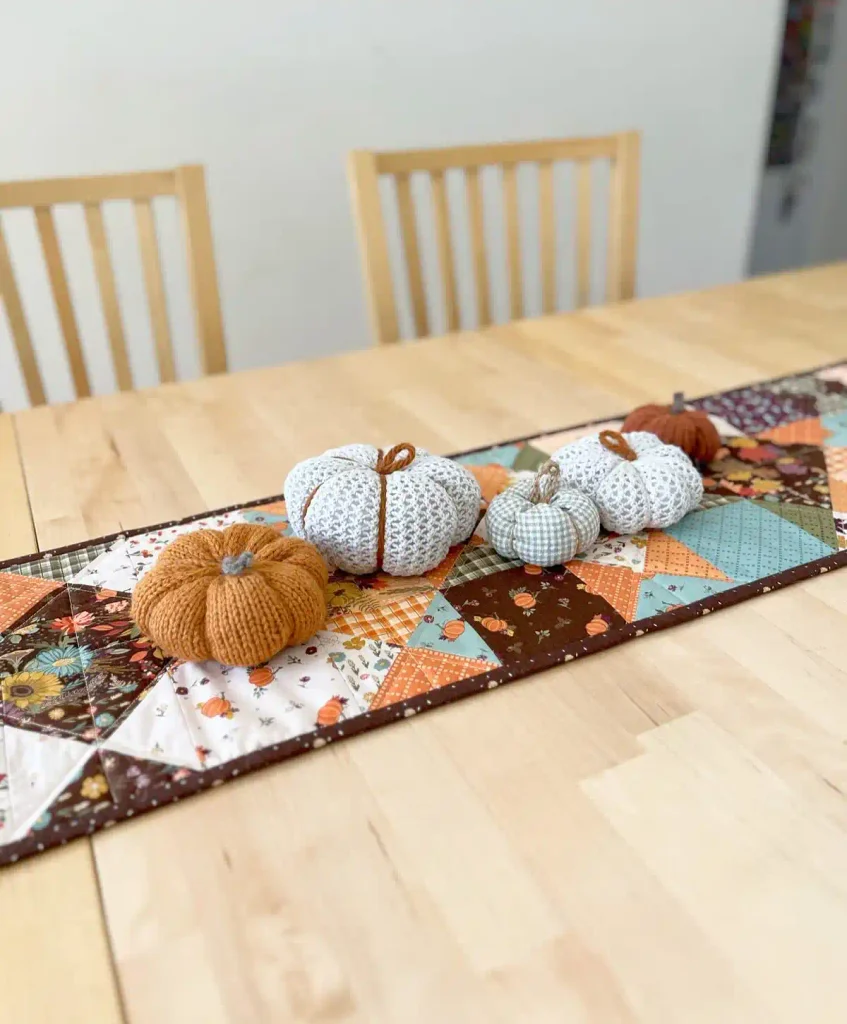
Half square triangles in warm floral and gingham prints build the base here, but the real star sitting on top is a cluster of knit and gingham fabric pumpkins in sage, cream, and mustard.
The runner alone is a solid, well-made piecing project. Styled with mismatched pumpkins on top, it becomes a whole tablescape moment.
| Runner Alone | Runner Styled |
|---|---|
| Clean triangle patchwork piecing | A layered, curated autumn vignette |
| Reads as craftsmanship | Reads as a finished tablescape |
If you’re making this pattern, don’t skip the styling step. A runner this well pieced deserves a few soft pumpkins scattered across it for photos.
19. Scrappy Patchwork Pumpkins March Across a Sweet Farmhouse Runner
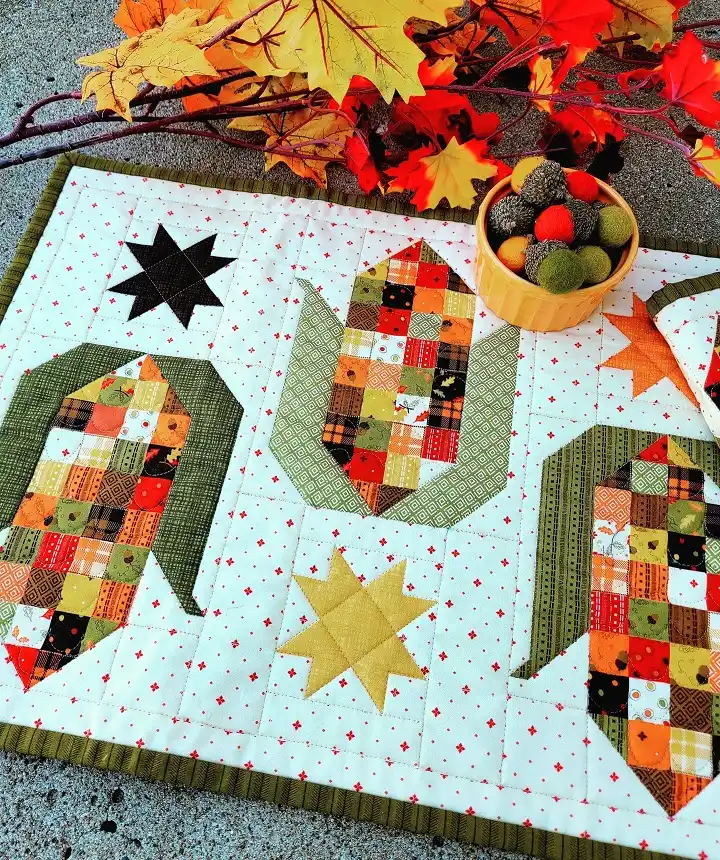
Every pumpkin on this runner is built from tiny scrappy squares in plaid, dot, and acorn prints, giving it a busy, handmade charm that a solid fabric pumpkin just can’t match.
Star blocks fill the gaps between pumpkins, alternating gold, orange, and one lone black star for contrast, all on a red dotted cream background with an olive green binding.
Watch out:
- Small scrap squares mean more piecing time than a single-fabric pumpkin block
- Keep your star block fabrics limited to two or three colors so the scrappy pumpkins stay the visual focus, not the stars
A bowl of felted wool acorns styled nearby matches the runner’s warm, cozy tone without stealing attention from the piecing.
20. Line Up Pieced Pumpkins Like Beads on a String for a Simple Statement Runner
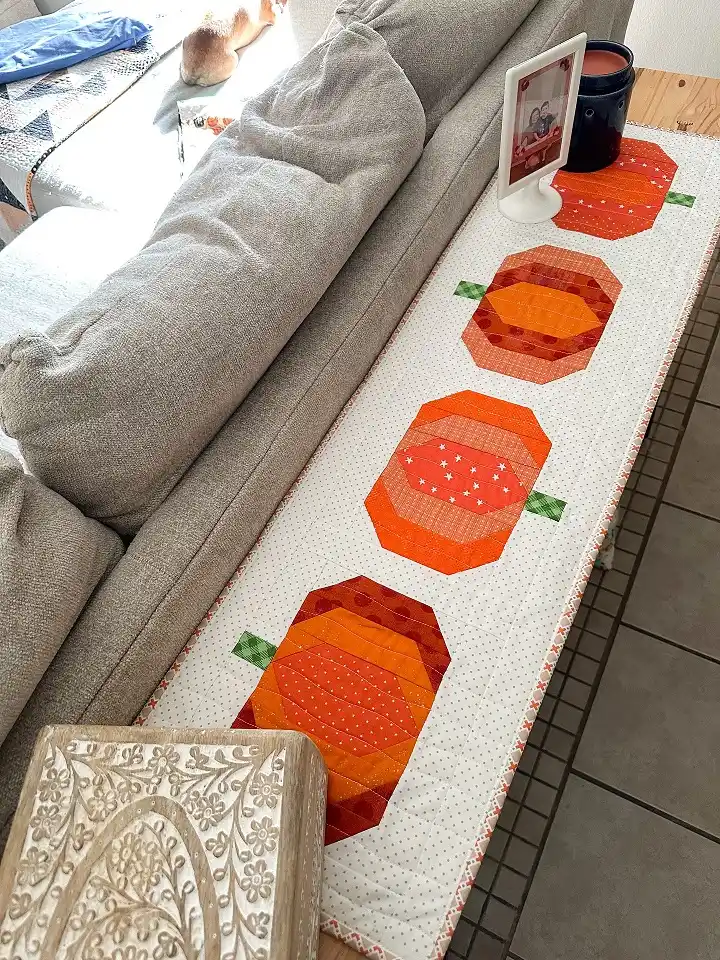
Four identical octagon pumpkin blocks in shades of orange, each with a tiny green fabric stem, march down a soft polka dot background on this runner.
There’s no border pattern competing for attention and no scrappy piecing distraction, just one repeated shape done cleanly, four times.
Recreate this look
Simplicity like this photographs well on nearly any surface, from a coffee table to a kitchen counter, because there’s nothing fighting for the eye’s attention.
21. A Handwoven Plaid Runner Proves You Don’t Need Piecing to Sew Autumn Décor
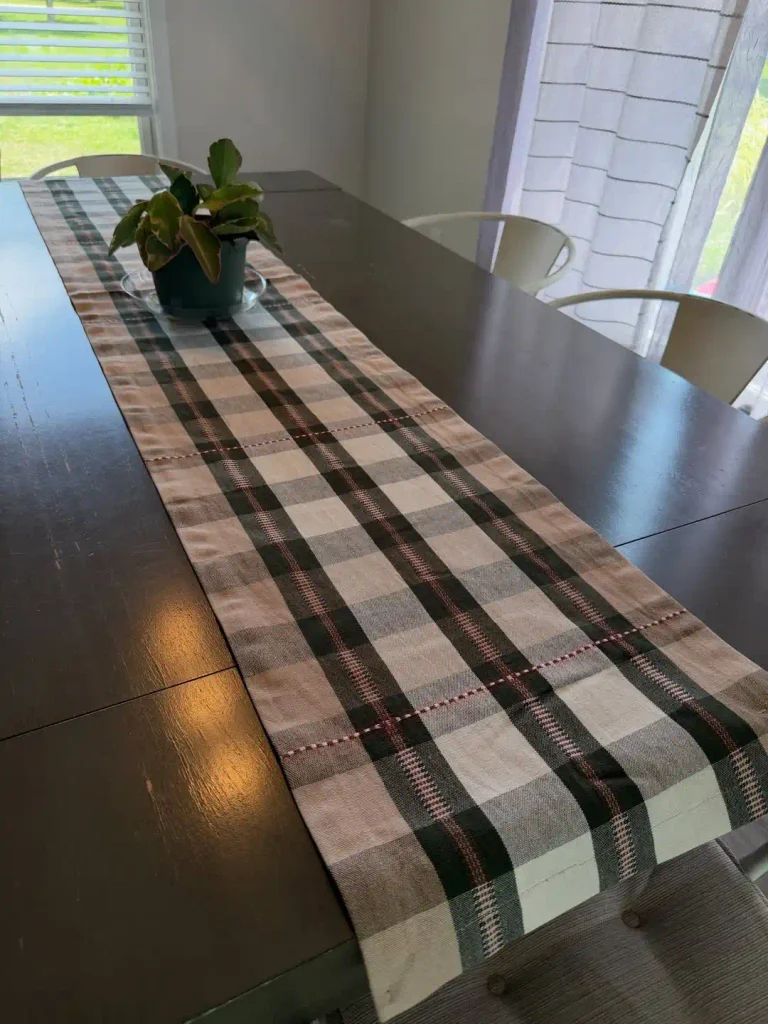
Woven plaid in forest green, tan, and cream needs almost no construction skill to become a runner, and this piece proves it.
A single length of plaid fabric, hemmed simply along the edges with one thin red stitched stripe running across, sits ready to use on any dark wood table.
If your machine time is limited this fall, projects like this exist for a reason:
- Cut one rectangle of a plaid or check fabric you love
- Fold and press a simple double hem on all four sides
- Straight stitch the hem down, no piecing, no binding
Sometimes the fabric itself is doing all the seasonal work, and the sewing is the easy part.
22. A Trick-or-Treat Patchwork Runner Loaded With Ghosts, Bats, and Candy Corn
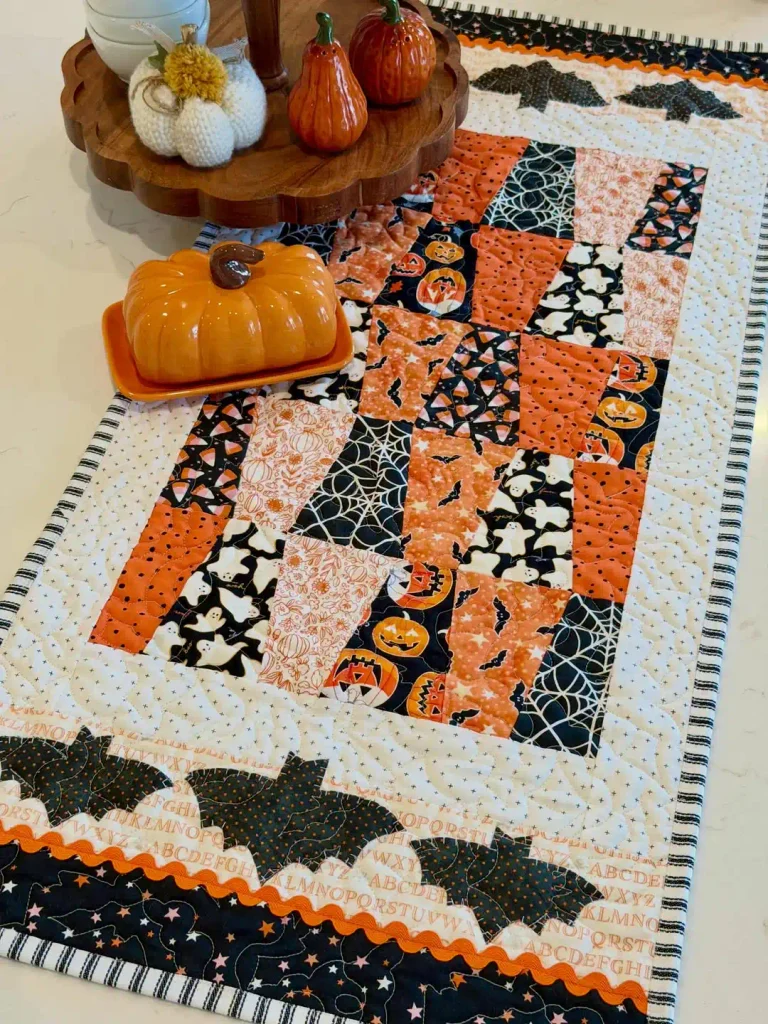
Every square inch of this runner is doing Halloween double duty.
A checkerboard of orange, black, and cream patches mixes spiderweb, ghost, jack-o-lantern, and candy corn prints, then hands off to a swooping bat appliqué border with an alphabet fabric strip and orange ric rac trim underneath.
What works here: the alphabet fabric border is an unexpected choice that keeps this from looking like every other Halloween runner. It reads almost like vintage schoolbook paper against the bold black bats.
23. A Modern Color Block Runner That Trades Prints for Bold Solid Fabric
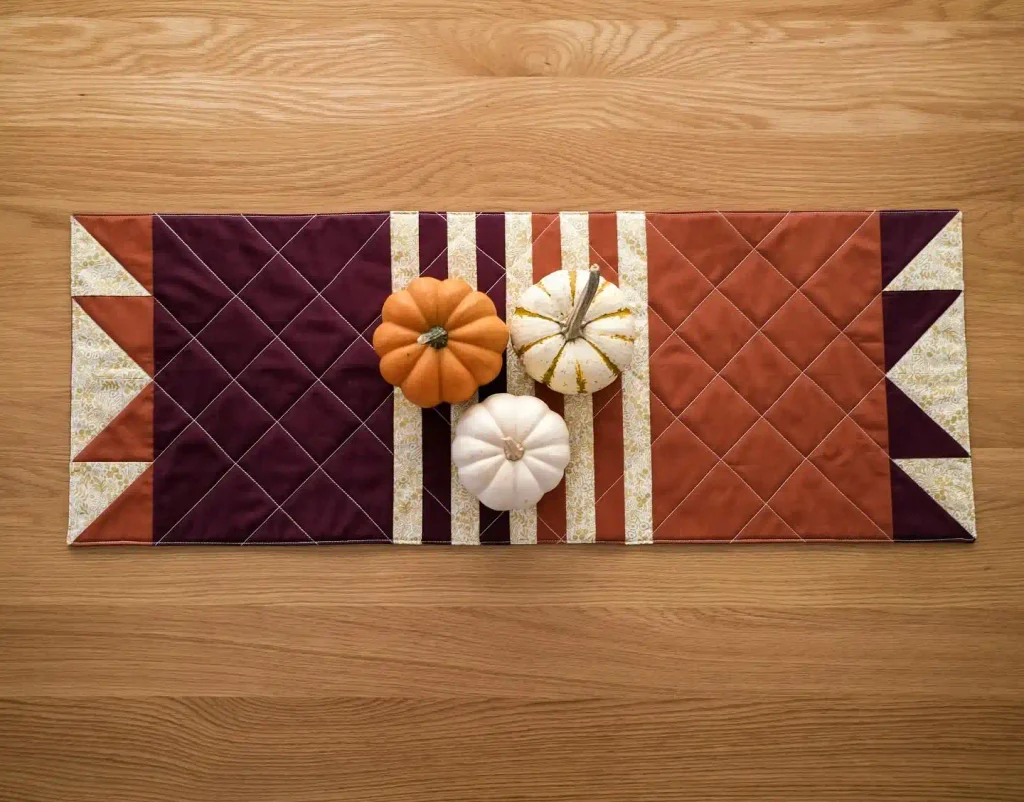
Deep plum and burnt sienna solids fill most of this runner, broken up by a narrow center strip of gold floral print and small flying geese units in the same two colors.
Diamond grid quilting covers every section, giving the solid fabric texture it wouldn’t have on its own.
This one skips prints almost entirely, which makes it the pick for anyone whose current table décor already has plenty of pattern.
Three tiny pumpkins sitting on top are the only busy detail in the whole photo.
What stands out:
- Solid fabric colors instead of prints keep the design graphic and modern
- Diamond quilting adds visual texture without adding busyness
- A single floral strip breaks up the solids just enough
24. Gingham Binding Is the Small Detail That Makes This Star and Pumpkin Runner Sing
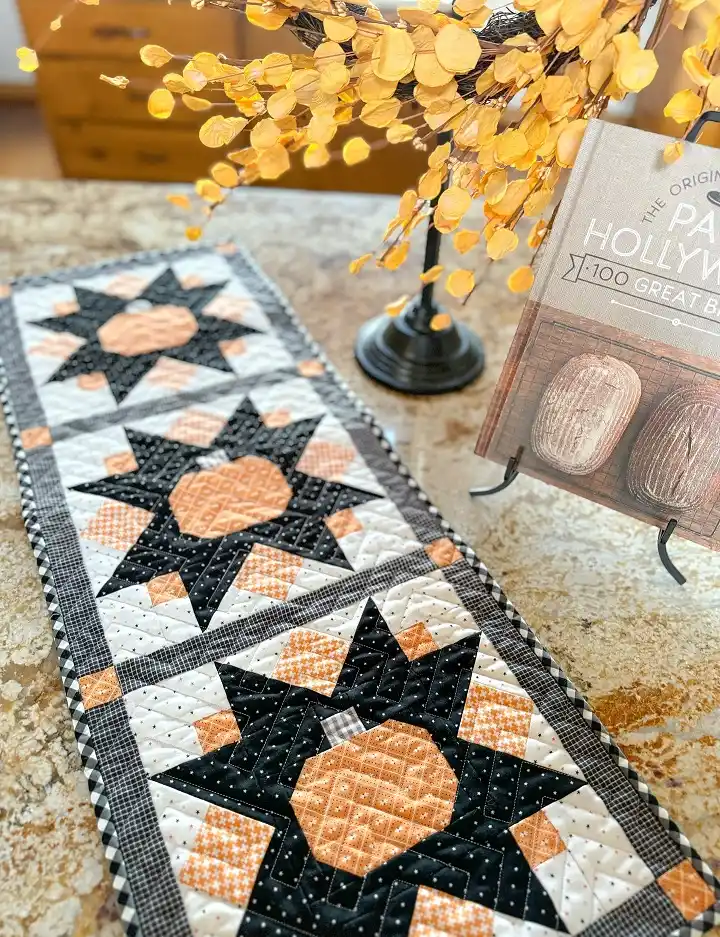
Star blocks in black and cream frame small pieced pumpkins running down this runner, but it’s the black and white gingham binding along both edges that pulls the whole thing together.
Without it, this would be a solid pumpkin runner. With it, the piece gets a crisp, finished border that photographs beautifully against granite or wood.
Before you skip the binding step on your next project, consider this comparison:
| Plain Binding | Gingham Binding |
|---|---|
| Functional but blends in | Adds a second intentional pattern |
| Invisible finishing touch | Frames the whole piece |
Small binding choices like this are often the difference between a runner that looks finished and one that looks almost finished.
25. A Jelly Roll Strip Runner in Lavender and Sage for Fall That Doesn’t Feel Traditional
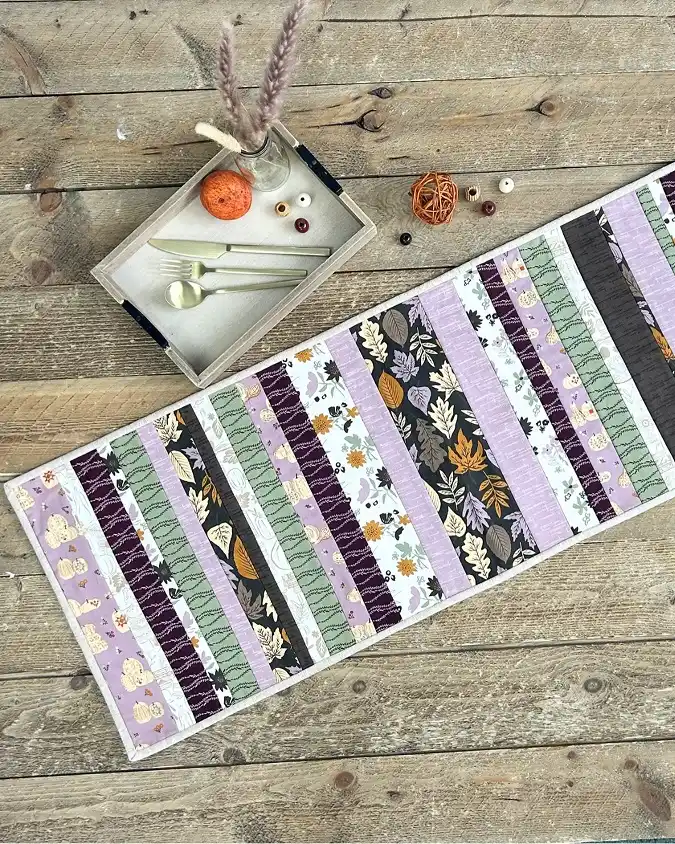
Vertical strips of coordinating prints, leaves, tiny pumpkins, ferns, and tone-on-tone solids, in lavender, sage, plum, and mustard, run the full length of this runner with no repeating pattern in the sequence.
It reads like a jelly roll came together in exactly the right order on the first try.
- Alternate print strips with solid strips so the eye gets a rest between busy sections
- Keep strip widths uneven, not every strip the same size, for a more organic finished look
- A soft neutral binding lets bold strip colors stay the focus
This palette is proof that fall sewing doesn’t have to live in orange and brown. Cool tones work just as well once you commit to a full set of coordinating prints.
Uneven strip widths and a cool color story keep a simple jelly roll runner from looking predictable.
26. Hand Embroidered Wildflowers Turn a Plain Linen Runner Into Heirloom Décor
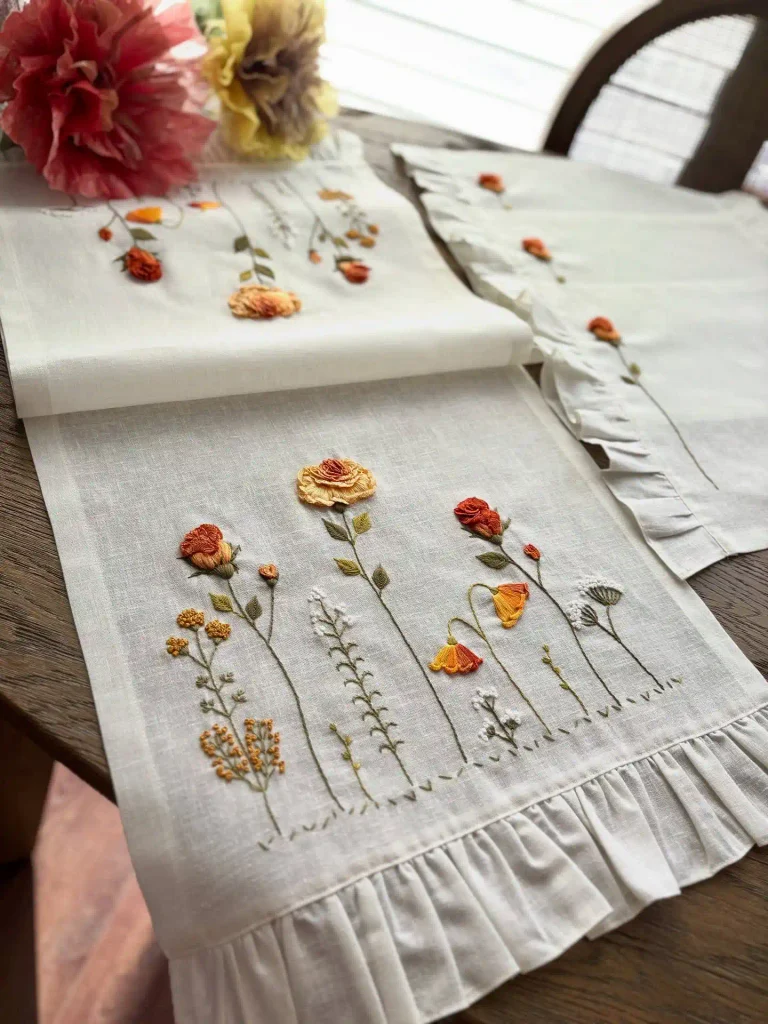
Delicate hand embroidered wildflowers in rust, gold, and cream stitch their way across a natural linen runner, finished with a soft gathered ruffle along the bottom edge.
Roses, bell shaped blooms, and tiny seed head clusters are worked in a mix of stitches, giving each flower its own texture instead of a flat, uniform look.
A slower project than most on this list, but worth the time:
- Sketch or trace a loose floral arrangement directly onto linen
- Work stems first in simple stem stitch before adding flower heads
- Vary stitch types across flowers, satin stitch for petals, french knots for buds
- Finish the edge with a gathered ruffle for a soft, feminine drape
This one rewards embroiderers who want a project to slowly build over several evenings rather than finish in a weekend.
27. A Muted Watercolor Plaid Runner for Sewists Who Want Fall Without the Orange
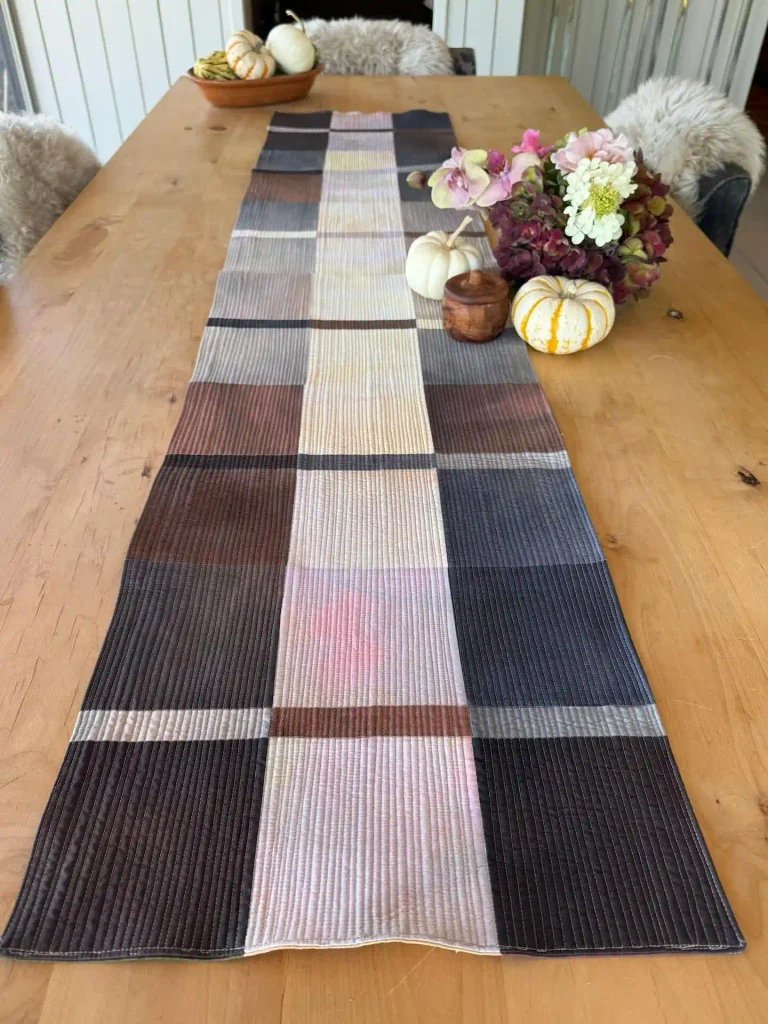
Soft brown, mauve, and gray blocks arranged in an oversized plaid grid give this runner a painterly, watercolor feel rather than a crisp graphic one.
Fine channel quilting runs vertically through each block, and the fabric itself looks hand dyed, with subtle color variation inside blocks that would otherwise read as flat solids.
A standard solid-block plaid grid layout.
A softened, painterly plaid using subtly variegated fabric.
The lesson here: choosing fabric with built-in tonal variation can make even a simple block grid feel custom and one of a kind.
28. Halved Pinwheel Blocks in Forest Green Bring a Botanical Feel to Fall Sewing
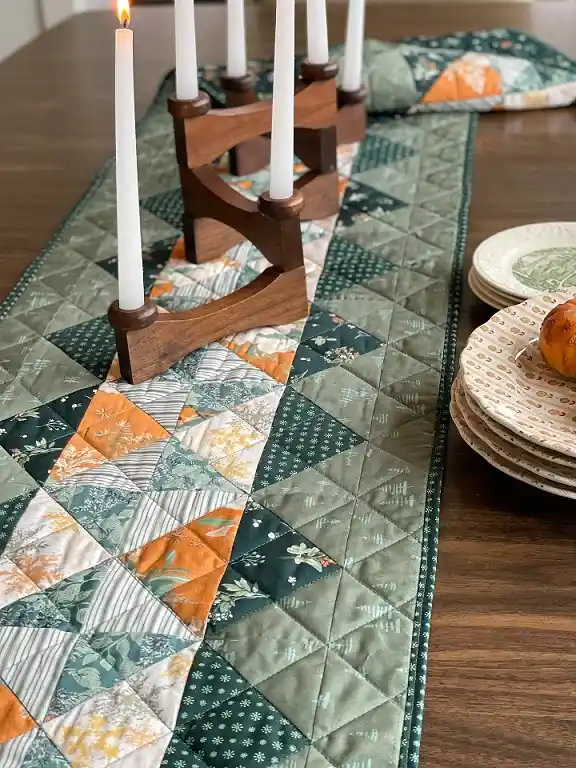
Half square triangles rotate into a pinwheel pattern across this runner, mixing deep forest green solids with botanical prints in orange, cream, and sage.
Tight diamond grid quilting fills every triangle, adding subtle sparkle under warm lighting.
A vintage-style candlestick and floral fabric plates styled nearby lean into a nature-inspired, almost autumn-garden mood rather than the usual harvest kitchen look.
Little details worth copying:
- Botanical print fabrics instead of pumpkin or leaf novelty prints
- Forest green as the dominant color instead of orange or rust
- Dense quilting that catches candlelight beautifully
If your fall table leans more garden party than harvest kitchen, this is the palette direction to study.
📌 Good To Know
Forest green as a dominant fall color, paired with botanical prints, gives a garden-party feel instead of the usual harvest look.
29. Layer Simple Appliqué Leaf Shapes on Solid Fabric for the Easiest Runner Yet
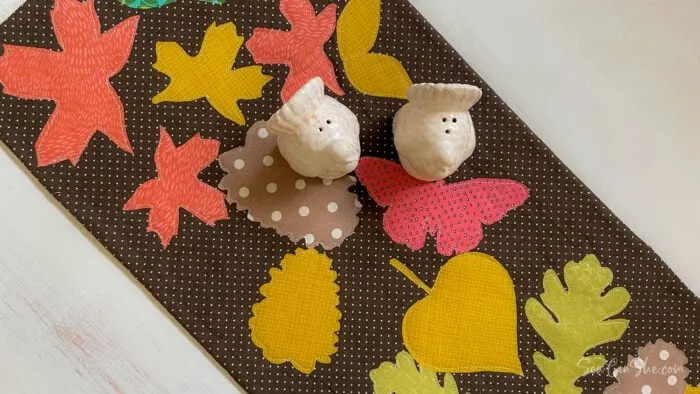
Overlapping leaf, maple, and oak shapes in coral, yellow, and gold sit scattered across a small brown polka dot panel, cut and layered rather than pieced into a grid.
Two ceramic bird salt and pepper shakers styled on top show just how compact this leaf collection is meant to be.
- Cut leaf shapes freehand from scrap fabric in three or four autumn colors
- Overlap edges slightly rather than spacing shapes evenly
- Fuse or pin shapes onto a solid dark background before stitching down
This scattered leaf layout scales up easily into a full runner length simply by repeating the same random cluster pattern down the fabric.
30. A Star Block Runner With an Appliquéd Acorn Wreath Center That Steals the Show
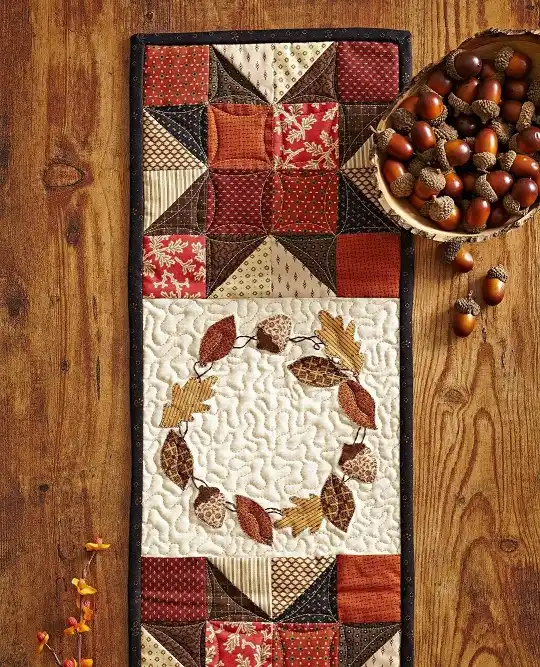
Traditional star blocks in red, cream, and brown bookend both ends of this runner, but the real showstopper sits in the middle: a full appliquéd wreath made from tiny leaf and acorn shapes, stitched onto a plain cream background with dense swirling quilting behind it.
A bowl of real acorns nearby echoes the wreath shape without competing with it.
What makes the center panel work:
- A plain, quiet background lets the wreath appliqué breathe
- Mixed leaf shapes, oak, maple, simple ovals, keep the wreath looking natural instead of stamped out
- Dense background quilting adds texture without adding color or clutter
Save the busiest, most detailed part of any runner for the center panel, and let the border blocks stay simpler by comparison. That contrast is exactly what makes this one feel finished.